If you have sat through corporate team building events that felt like mandatory fun, you already know the problem. Activities that don’t land. Energy that never picks up. The best corporate team building events don’t feel like events at all, they feel like momentum. Here are 7 proven approaches that actually work.
Most corporate team building events fail because they’re planned around an activity, not an audience. The events that generate real results, tighter collaboration, higher morale, stronger communication, are designed with a specific outcome in mind before anyone picks an activity.
The best corporate team building events answer three questions first: Who is this room? What do they need to feel? What should they leave with? Every energy moment in high performing corporate team building events traces back to those three questions. Research from Harvard Business Review confirms that investment in people focused programming delivers measurable returns.
One of the most underused formats in corporate team building events is the music driven warm up. The room’s energy is set by what happens in the first five minutes. Events that open with intentional music programming immediately shift how attendees engage with everything that follows.
At No Stress Zone Entertainment, we design corporate team building events where music is a tool, not an afterthought. Programs that use music strategically see faster audience buy in and longer sustained energy throughout the program.
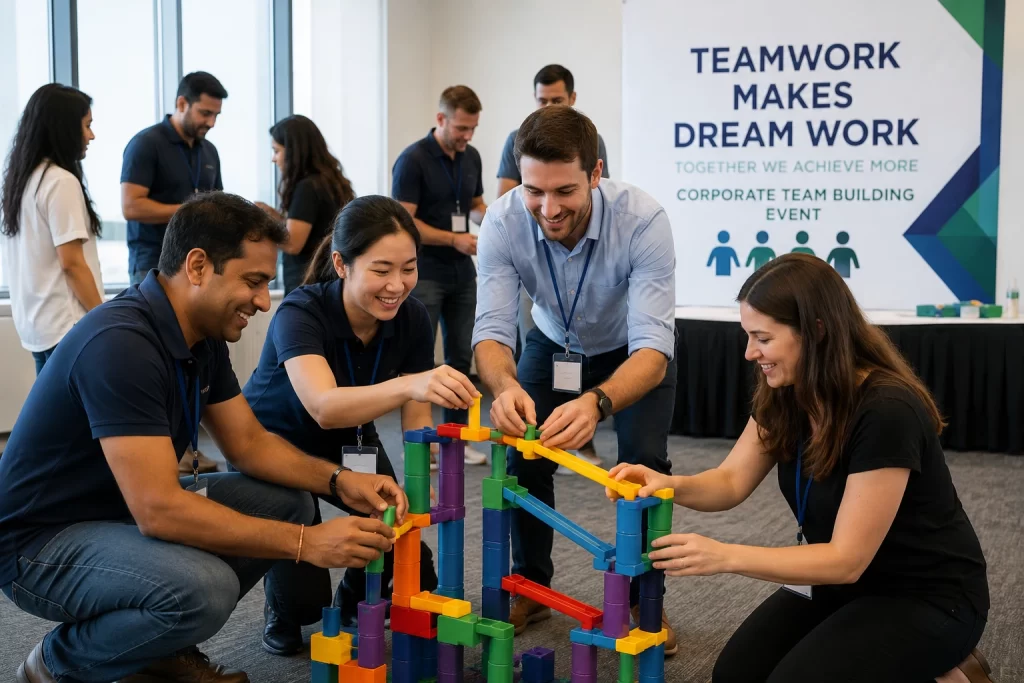
The most effective corporate team building events use structured competition to create natural collaboration. Not head to head competition that creates winners and losers, team based challenges where cross departmental groups solve something together under a time constraint.
Programs built around collaborative competition accomplish something icebreakers never do: actual shared experience under mild pressure. The debrief is more important than the competition itself.
For corporate team building events using competition formats, keep teams mixed across departments. The most powerful of these events put the VP of Sales on a team with a junior coordinator and let them figure out how to win together.
Team building programs that teach something tend to stick longer than those that just entertain. Experience design workshops ask teams to solve a real company problem, redesign onboarding, reimagine the all hands, map the customer journey. These programs generate both connection and tangible output.
The best programs in this format end with a brief presentation to leadership, which amplifies the investment everyone brings to the work.
Unstructured networking hours are the graveyard of corporate team building events. The opportunity to build cross functional relationships, the entire point of the program, gets wasted in small talk. The fix is structure.
The corporate team building events that execute networking well use guided connection formats: curated conversation prompts, rotating speed networking, or facilitated discussions. Well designed events treat networking as a designed experience rather than free time.
Events with a skilled host perform dramatically better. The host controls pacing, breaks awkward silences, and keeps the room moving. Without a host, corporate team building events self organize around existing social hierarchies, defeating the purpose.
Events that connect to a larger purpose generate a different kind of engagement. Service projects, building care packages, supporting a local nonprofit, give corporate team building events emotional weight that pure entertainment cannot.
The key to making these corporate team building events work is integration. The best programs in this format connect the service activity directly to company values with a facilitator who draws the explicit connection back to how the team works together daily.
One of the most energizing formats for corporate team building events is the live simulation challenge. Teams plan and execute a five minute live experience for the rest of the group with limited time and total creative latitude. These programs reveal leadership styles and communication patterns in ways no traditional activity can match.
The team that wins isn’t the one with the most elaborate idea. It’s the team that organized fastest and committed fully. Corporate team building events like this don’t just build teams, they reveal them.
The most overlooked element in these events is the close. Programs that create lasting impact close with intention: a recognition moment, a shared commitment, a team declaration. Something that signals: this mattered.
At No Stress Zone Entertainment, we design corporate team building events where the close is as carefully engineered as the open. The close of a well designed program sends people home feeling they were part of something real, and that drives behavior change back in the office.
Not all corporate team building events fit every audience. Programs designed around a specific problem, low morale after a reorg, communication friction, a team that doesn’t know each other yet, always outperform events designed around what sounded fun in a planning meeting.
The gap between events that people dread and events people talk about six months later is design. When these programs are built around a clear outcome and executed with sustained energy, they work. Our team can help you design corporate team building events that actually move your room.
Corporate team building events work best between 90 minutes and half a day. Full day programs work for retreats, but most teams hit a wall around four hours. Design your event with energy management in mind, alternating high activity and reflective moments keeps engagement consistent.
Corporate team building events are specifically designed around relationship development and skill alignment, not information delivery. The best programs use structured interaction to generate trust and cross functional familiarity that passive events cannot produce.
Yes, but the design must account for the medium. Virtual corporate team building events that replicate in person formats without adapting to the platform almost always underperform. The best programs for remote teams use shorter activity blocks and more facilitated interaction.
The most honest measure is behavior change over time, do people collaborate differently? The real ROI shows up 30 to 90 days later in how the team actually functions, not just in post event survey scores. According to Gallup, teams with high engagement outperform their peers by 23% in profitability.
The Complete Planner’s Guide to Corporate Team Building Events
Planning effective corporate team building events requires more than booking a venue and picking an activity. The planners who consistently deliver results treat every element of the program as a design decision, from the pre event communication that primes attendees to the post event follow through that sustains whatever the team built together.
Start With the Why
Before any activity gets selected, the organizer needs to answer one question clearly: what specific outcome does this program need to deliver? General objectives like “improve morale” or “build culture” produce general results. The programs that actually shift how a team operates are those built around a specific, observable outcome, better cross functional communication, stronger trust between two departments that need to collaborate more effectively, a shared understanding of the company’s direction after a significant change.
Once the outcome is defined, every programming decision flows from that anchor. The activity, the format, the facilitation approach, the closing moment, all of it gets evaluated against whether it serves the defined outcome. This is the difference between an event that generates positive survey scores and an event that generates positive behavior change.
Audience Analysis Before Activity Selection
The audience for any team development program is never homogeneous. In most corporate environments, you have people who are naturally energized by group activities and people who find them draining. People who are skeptical of anything that feels like forced fun and people who genuinely enjoy it. People who are new to the team and people who have worked together for years. Designing for the average attendee means designing for no one specifically.
The most effective programs design for the edges as much as the center. They include moments where the naturally energetic can shine and moments where the naturally reflective can contribute. They build in enough structure that introverts aren’t exposed, and enough spontaneity that extroverts don’t lose interest. The format should create conditions where every type of person in the room finds their way to engage genuinely.
Sequencing and Energy Management
Even the best activity will underperform if it is sequenced incorrectly. An energetic physical challenge placed right after lunch produces sluggish participation. A reflective group exercise placed first thing in the morning, before the room has warmed up, produces surface level answers. Sequencing is the art of matching activity type to the energy state the audience is actually in.
The most effective programs build energy progressively: lower stakes activities early that warm the audience and build trust, followed by higher engagement challenges as the program deepens, closing with a meaningful collective moment. This arc is not accidental. And it is the sequencing that most off the shelf programs get wrong.
The Role of Professional Facilitation
The facilitator is not a neutral presence in corporate team building events. They are the person who reads the room in real time and adjusts when something is not landing. They manage the energy between activities, create the conditions for genuine participation, and hold the thread that ties each moment to the larger objective. Without skilled facilitation, even well designed corporate team building events can drift.
Professional facilitation is the difference between a program that serves the plan and one that serves the people. On a poorly facilitated program, the plan wins even when it stops working, activities run their full allotted time because the schedule says so, not because the room is still engaged. A skilled facilitator will cut an activity short that has lost the room and extend one that is generating real energy, and that kind of live judgment call is what internal HR staff running their first team building event almost never have the reps to make.
Measuring Impact After Corporate Team Building Events
The measurement framework for corporate team building events should be established before the event, not after. What will you observe in the 30 days following that tells you it worked? Defining the observable outcome in advance gives leadership a clear rationale for the investment.
Post event surveys tell you how people felt on the day. The real measure shows up weeks later in how people actually work together. The best corporate team building events are investments in long term team performance, not one day experiences that feel good and leave no trace.
Concrete signals worth tracking: whether cross team Slack or Teams messages between departments that did not talk before the event increase in the following month, whether meeting participation from quieter team members changes, and whether managers report fewer handoff issues between teams that were paired during activities. None of these show up in a same day feedback form. All of them show up if you look thirty days out.
Key Takeaways
- The room’s energy is set in the first five minutes, design your opening with the same care as your content.
- Structured experiences outperform unstructured free time every time.
- Post event follow through determines whether the investment generates lasting change or just a pleasant memory.
Team building is one piece of a broader employee experience strategy, see our full approach to corporate events for employees for the bigger picture.
Proof from the room: see how we hosted 45 Johnson & Johnson volunteers through a first aid kit build.
Related Reading
- Employee Appreciation Event Entertainment: 7 Best Ideas
- Corporate Retreat Entertainment: 5 Best Options
Why Some Team Building Backfires
Team building activities backfire most often when they’re built around forced enthusiasm rather than genuine choice. Mandatory participation in an activity that some employees find uncomfortable, physical challenges, public performance, personal vulnerability exercises, tends to produce resentment that outlasts any short term bonding effect. The teams that report the best experience are almost always the ones given a real choice between two or three activity formats, rather than one activity everyone is required to join.
A second common failure point is scheduling team building at the end of a long conference or work day, when energy is already depleted. An activity designed to build connection lands very differently at 9 AM with a fresh group than it does at 5 PM after eight hours of sessions, when attendees are mentally checked out and just want the day to end. If team building is meant to be a highlight, protect it a prime energy slot rather than treating it as a closing filler item.
The activities that actually build lasting team cohesion tend to have a shared outcome the group can point to afterward, something built, solved, or created together, rather than pure entertainment consumption. A group that watched a performance together bonds less than a group that collaborated on a challenge with a visible result. If budget allows for only one team building investment, prioritizing a collaborative format over a passive one tends to produce a better return on the spend.