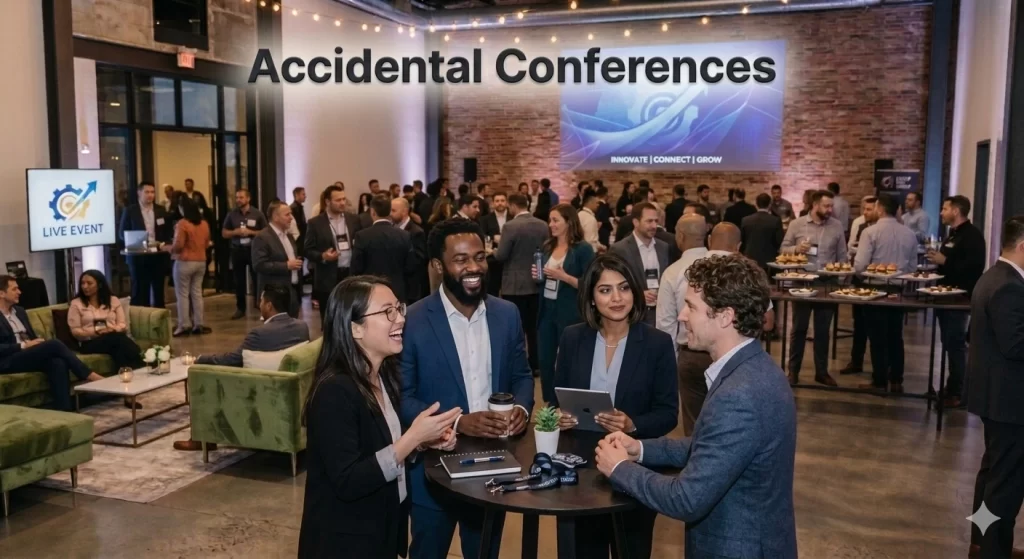
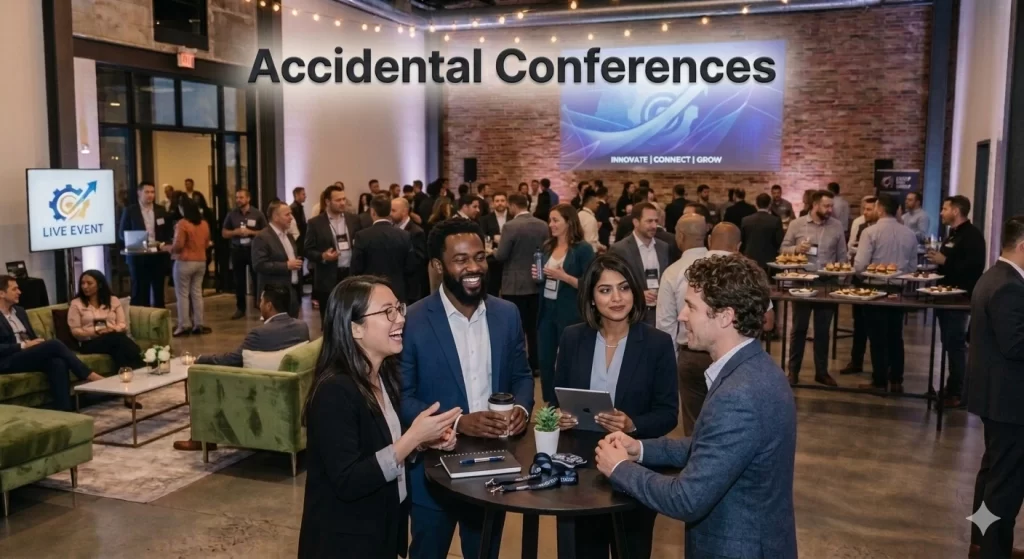
Accidental conferences are the corporate events that were never really designed. They exist because they always have. Nobody named the outcome. Nobody defined the audience shift. Nobody built the arc. The event happened because it was on the calendar. Attendees showed up because they were told to. Money got spent because the vendor contracts were already in place.
Accidental conferences look like real conferences from the outside. Same registration desk. Same lanyards. Same lunch break. But nothing about them was designed to change anyone in the room. That is the hidden cost.
What Accidental Conferences Actually Are
An accidental conference is any corporate program that ends up existing without a clear reason to. The annual sales meeting that nobody really wants but everyone attends. The offsite that got scheduled because the last one happened. The leadership summit that has three days of content and one hour of actual outcome.
The tell is simple. When you ask the sponsor what changes for the attendee after the conference, they cannot answer. That is an accidental conference. The event happened. Nothing shifted.
Why Accidental Conferences Keep Happening
Nobody plans an accidental conference on purpose. They happen because momentum is the default. Last year’s event happened, so this year’s event will happen. The vendors are booked, the venue is held, the invites go out. The default of continuing to run the event is always easier than the default of naming what it is for.
That drift is what turns a real conference into an accidental one over time. The event survives past the original need. Nobody notices until someone asks what actually changed for anyone in the room.
The Hidden Cost of Accidental Conferences
The obvious cost of this pattern is the budget. Venue, catering, AV, speakers, printing, travel. All real, all measurable, all wasted when the event does not produce a shift.
The hidden cost is larger. Attendee time. Executive attention. Brand credibility. Every accidental conference teaches your audience that your events are optional. That lesson compounds. Two the drift in a row and top attendees stop showing up. Three in a row and your event program is dead as a business tool.
What Attendees Actually Notice at Accidental Conferences
Attendees notice when the agenda is filler. They notice when the sessions repeat the same content from last year. They notice when leadership seems bored by their own event. They notice when nobody in the room can name the outcome. All of that gets encoded as a reason not to prioritize the next invite. That is the compounding damage of these programs.
Why Accidental Conferences Are Especially Expensive for Corporate Brands
Corporate brands running the phenomenon pay double. First, they pay the direct cost of the event. Second, they pay in brand erosion because the audience walks away thinking the brand is going through the motions.
When a client attends a corporate conference or summit and walks out thinking that was a waste of time, the brand takes a hit that no ad spend will repair. Accidental conferences are one of the highest cost mistakes in corporate marketing precisely because the damage is invisible on the P and L.
How Accidental Conferences Happen Inside Growing Companies
Growing companies are especially vulnerable to this problem. The first version of the event solved a real problem. Bring the team together. Align on strategy. Introduce a new product. But the reason for the event does not scale automatically. The company changes. The audience changes. The event does not.
Three years in, the event is running on inertia. The original outcome is gone. Nobody redesigned it. That is how a real conference quietly turns into an accidental conference.
How to Stop Running Accidental Conferences
Ask three questions before every event. What outcome does this need to produce for the attendee? What behavior should change afterward? How will we measure whether the change actually happened?
If any of the answers are vague, redesign the event. Or cancel it. Running default events is worse than running fewer events. Fewer events with real outcomes build brand equity. Accidental conferences erode it.
The Redesign Playbook for Accidental Conferences
Start with the audience shift. What should attendees think, believe, or do differently after the event. Reverse engineer the program to protect that shift. Cut every session that does not contribute. Design experience layers that reinforce the shift in real time. Music. Pacing. Transitions. Peak moments.
Redesigning an accidental conference into a real one is not glamorous work. It is subtractive as much as additive. Cut before you add. Name the outcome before you fill the agenda.
How Execution Turns a Conference From Accidental to Intentional
Even a well designed conference can drift into feeling accidental if the execution is loose. Sloppy transitions. Playlist music instead of real time direction. Speakers running long with no recovery plan. That is why execution matters even after the redesign work is done.
An intentional conference has an operator in the room protecting the arc. That operator makes the calls that keep the outcome on track when the timeline shifts. Without that layer, the redesign work erodes in real time.
Warning Signs of Accidental Conferences
The agenda looks like last year’s. Sponsor cannot name the specific outcome. Attendee feedback trends flat. Leadership presence declines year over year. Repeat attendance drops. If you see two or more of these, you are running inertia driven events.
The good news is these are all reversible. Name the outcome, redesign the program, hire real execution in the room, and the conference climbs back out of accidental territory.
The Bottom Line on Accidental Conferences
Accidental conferences look like real conferences and cost like real conferences. But they do not produce a shift. The hidden cost shows up in attendee time, brand credibility, and the compounding damage of teaching your audience that your events are optional.
Want a partner who helps redesign drift events into intentional ones? Request a custom event experience and we will scope the next redesign together.
The Compounding Damage of Accidental Conferences
The worst damage from these gatherings is not one event. It is the pattern. Two years in a row of this pattern and top attendees start declining the invite. Three years in a row and executive sponsors stop showing up. Five years and the event program is unrecoverable as a business tool.
That is why catching unintentional conferences early matters. One accidental conference is recoverable. A pattern of them destroys credibility in a way that takes twice as long to rebuild as it took to erode.
How Executive Sponsors Miss Accidental Conferences
Executive sponsors miss default programs because they see the metrics that make the event look successful. Attendance held. NPS is fine. Speakers hit their marks. Nobody complained on stage. But the metrics that actually matter are downstream. Repeat attendance. Behavior change after the event. Referrals from attendees. Those are the metrics that expose these summits.
If your executive team is not tracking those downstream metrics, legacy events will keep sneaking through the review cycle for years.
Case Example: A Conference That Got Rescued from Accidental
A tech company ran a customer conference for five years. Attendance was flat. NPS was middling. Sponsor could not name the outcome. Classic inertia events pattern. Leadership finally asked the question. What should attendees leave believing that they did not believe walking in?
They redesigned around that answer. Cut two thirds of the sessions. Added three peak moments. Hired real time execution. The next year, attendance was up. NPS jumped. Repeat attendance climbed. Same conference, different design. That is what rescuing an accidental conference looks like.
The Budget Reallocation for Fixing Accidental Conferences
You do not need a bigger budget to fix these events. You need a smarter allocation. Cut ten percent from decor and stage. Add it to experience design and real time execution. That single reallocation fixes more this pattern than any content refresh.
Most the drift overspend on visible things and underspend on the invisible layer that actually decides the outcome. Fix the ratio and the conference stops being accidental.
Culture Impact of Running Accidental Conferences
Teams that run these programs internalize a certain default. Events are about production, not outcomes. That default leaks into every other program the team runs. Marketing events. Customer events. Employee events. The whole event portfolio drifts into accidental territory.
Fixing one accidental conference resets the standard for the whole portfolio. It teaches the team that events are supposed to produce a shift, not just fill a room. That cultural upgrade is worth more than the specific event fix.
How to Prevent New Accidental Conferences
Before every new event, run a three question check. What outcome should this produce. What audience shift should we measure. What happens if we cancel it. If any answer is vague, redesign or cancel before the calendar locks. That single discipline prevents these conferences from taking root in your event portfolio.
Prevention is cheaper than rescue. The best time to catch an accidental conference is before the venue contract is signed.
How to Talk to Executives About Accidental Conferences
Executives who fund accidental conferences do not want to hear that their event is not working. Frame the conversation around outcomes and downstream metrics, not criticism. Show the repeat attendance decline. Show the flat NPS. Show the survey responses that reveal attendees cannot name the outcome.
Then propose a redesign that keeps the venue, the budget, and the calendar slot. Executives will fund the redesign of an accidental conference far more easily than they will fund canceling it. Use that reality to your advantage.
Timeline for Rescuing Accidental Conferences
Ninety days out. Name the audience shift. Cut the sessions that do not contribute. Sixty days out. Design the peak moments. Rebuild the run of show. Thirty days out. Hire the real time execution. Confirm vendor coordination. Ten days out. Rehearse transitions. Day of. Protect the arc.
That timeline turns accidental conferences into intentional ones inside three months. Any team can run it. Very few teams do.
Common Objections About Redesigning Accidental Conferences
Objection one. Attendees expect the same format. Attendees expect a good event. Format is negotiable. Objection two. Vendors are already contracted. Contracts have change orders. Objection three. Leadership is comfortable with the current design. Comfort is the enemy of accidental conferences.
All three objections are surmountable. What is not surmountable is a pattern of accidental conferences that erodes attendee trust for another five years.
Long Term Damage of Accidental Conferences
The compounding cost of accidental conferences goes beyond attendance decline. It shapes how the market sees your brand. Vendors talk. Attendees talk. Executives at other companies hear about the event. If your accidental conferences develop a reputation for being forgettable, that reputation follows your brand for years.
Rescue the event now. The market memory is long. The cost of doing nothing keeps growing.
Final Word on Accidental Conferences
Accidental conferences are recoverable. The path is not glamorous. Name the outcome. Cut what does not contribute. Hire the real time layer. Measure the downstream metrics. Do that discipline once and the conference stops being accidental. Do it every year and your event program becomes a real business asset.
The teams that catch accidental conferences early build stronger event portfolios over time. Every corrected event teaches the team a lesson about outcomes over activity. That lesson compounds. Five years of intentional events produces a portfolio no competitor can copy.
Fix one accidental conference now. Prevent the next three. Build the portfolio your executive team actually needs.
Great event programs are built on refusing to accept accidental conferences as normal. That refusal has to start somewhere. Let it start with your next event on the calendar. Name the outcome. Cut what does not contribute. Execute in real time. That is the standard the whole portfolio needs.
Proof from the room: see how we ran the mic all day at the Alliance for Science East Coast Conference, and every industry we have worked in, with proof.
Related Reading
- High Stakes Events: 5 Reasons Yours Are Not Delivering Results
- The Invisible Work Behind Every Seamless Corporate Event
- Sales Kickoff Theme Template: 7 Proven Frameworks That Work
- Creative Sales Meeting Themes: 9 Growth Focused Ideas
Frequently Asked Questions
What is an ‘accidental conference’?
Any corporate program that ends up existing without a clear reason to, the annual sales meeting nobody really wants but everyone attends, or the offsite that got scheduled just because the last one happened. It looks like a real conference from the outside but wasn’t designed to change anyone in the room.
How can you tell if an event is an accidental conference?
Ask the sponsor what changes for the attendee after the conference. If they can’t answer, that’s the tell, the event happened, but nothing shifted.