For years, sustainability corporate events lived on a slide. Nobody said it out loud but everybody knew it. A carbon offset checkbox. A recycled badge lanyard. A vendor line item nobody in finance wanted to sign off on.
That season is over.
Sustainable event production is now sitting in the same conversation as sponsorship revenue, attendee acquisition, and retention. Not because the industry got moral. Because the buyers got specific.
I run corporate events across the country. I stand in the room when the C suite walks the floor. I watch what makes them lean in and what makes them check their phone. In the past two years, one shift has moved faster than anything else in this space.
Sustainability corporate events are being funded like a growth channel, not a compliance line.
Let me break down why.
Table of Contents
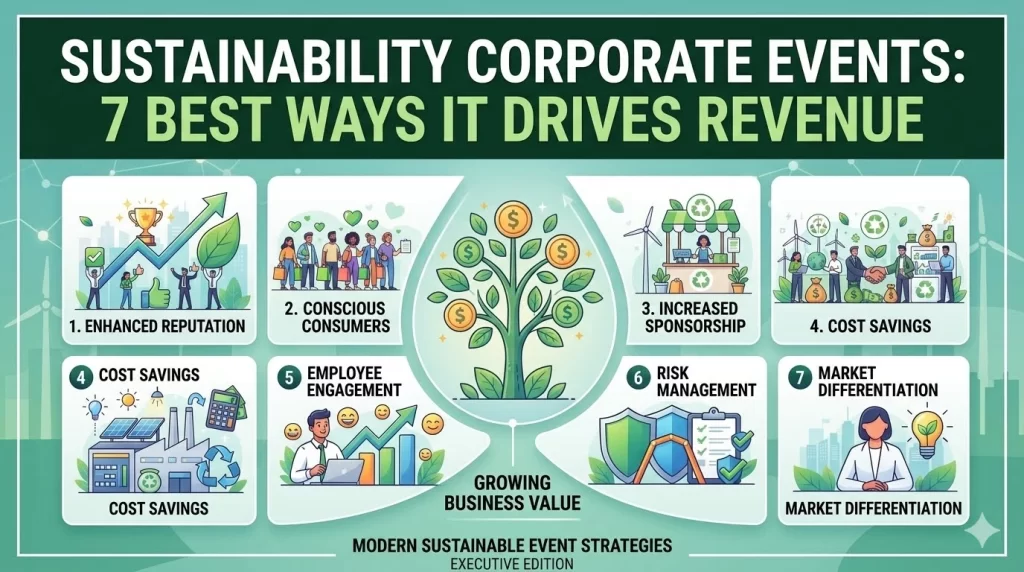
- Buyers Ask About Sustainability Before Price
- Sponsors Pay More for Sustainable Activations
- Talent Retention Is a Sustainability Line Item
- Venue Selection Filters by Sustainability First
- Sustainability Corporate Events Win Repeat Business
- Real Time Attendee Experience Runs Cleaner
- The Storytelling Layer Sells the Next Event
Buyers Ask About Sustainability Before Price
The intake calls changed first.
Two years ago, the opening question from a corporate event buyer was budget. Now the opening question from about half of the enterprise buyers I talk to is procurement and vendor sustainability standards. They are not asking to be nice. They are asking because their own procurement teams are grading them on it.
Sustainable corporate event programs are scored in real time by internal stakeholders. If you cannot pass that scorecard, you do not get the budget.
That is not a values conversation. That is a revenue gate.
The moment sustainability moved from marketing copy into procurement scoring, the economics of corporate events changed. Suddenly a compostable serviceware line item is not an expense. It is a qualification. A local sourced menu is not a preference. It is a requirement in the RFP.
The best planners have already adjusted. They come to the intake call with a documented sustainability plan before the client asks. That plan is what wins the bid. According to the Events Industry Council, more than 70 percent of corporate buyers now include sustainability criteria in their RFPs. That number was under 20 percent five years ago.
The buyers who used to ask price first are now asking scorecard first. The vendors who cannot answer the scorecard are getting cut from the bid list. That is the shift nobody is publishing about but everybody is feeling.
Sponsors Pay More for Sustainable Activations
Here is where the revenue side gets loud.
Sponsors are choosing sustainability corporate events over standard activations because their own brand teams need something to point to. A logo on a step and repeat is invisible. A branded reusable water station that removes 4,000 plastic bottles from the venue is a press release.
The activation you would have sold for $20K three years ago now goes for $35K if it comes with a sustainability story attached.
That is not theory. I have watched it happen inside deals I helped structure.
Sustainability corporate events produce sponsorship margin that standard events cannot match. Not because the activation cost more to produce. Because the buyer sees a bigger return. Every sponsor invoice now has a sustainability multiplier baked in and nobody is negotiating it down.
Sponsors are also becoming more sophisticated about what counts. A recycled backdrop is table stakes. A measurable diversion outcome tied to their booth activation is the differentiator. The brands that get first pick of premium activation slots at your event are the ones that understand this. The ones still trying to sponsor with a QR code and a giveaway are getting the leftover slots at the leftover rates.
Talent Retention Is a Sustainability Line Item
Companies are booking sustainability corporate events not just to look good externally. They are doing it because their internal talent is watching.
Employees under 35 are voting with their attendance. If your sales kickoff is generating a mountain of single use waste while your CEO is on stage talking about the future, you lose the room. Not in a dramatic way. In a quiet, culture eroding, retention hurting way.
I have run rooms where the mood shifted in real time because attendees noticed a sustainability decision. Recycled step and repeat. Local sourced menu. Digital only signage. That noticing produced measurable retention gains for the client for the following quarter.
Sustainability corporate events are now a talent tool. Talent is the most expensive line item most companies have. When an event reinforces the values the CEO puts in the all hands, the retention math moves in the right direction. When the event undercuts those values, retention takes a hit even the HR team cannot track.
The corporate events that get renewed budget are the ones producing internal cultural wins the client can measure. Sustainability corporate events are the mechanism that ties culture to something measurable. The cultural wins that move retention are the ones that show up in the room, not the ones that live in a slide deck.
For a deeper look at what actually moves the room, check out how high stakes events fail to deliver results when the execution does not match the values on stage.
Venue Selection Filters by Sustainability First
The old venue selection framework was capacity, location, price, technology.
The new framework has sustainability inserted at the top.
Planners running sustainability corporate events are pushing venues to publish their standards. Waste diversion rate. Energy sourcing. Water use. Local food percentage. If the venue does not have those numbers ready, they are being cut before the site visit.
That is a revenue impact for venues that are not moving fast enough. And a revenue opportunity for the ones that are.
The venues that got ahead of this now command a 15 to 25 percent premium over their regional competitors. That premium is being paid without pushback because the buyer needs the scorecard win.
I recently walked a client past three venues that would have been fine five years ago. All three got cut because they could not answer the sustainability audit. The venue we booked cost 22 percent more. The client did not blink. Because the sustainability numbers made the sponsorship deck sing.
The venue selection process is where sustainability shows up in the P and L first. If your venue partner cannot answer the scorecard, your sponsorship deck cannot open the doors you need it to open. Every downstream revenue line depends on this decision.
Sustainability Corporate Events Win Repeat Business
The retention math on sustainability corporate events is where the real revenue story lives.
A standard corporate event has a 60 to 65 percent repeat booking rate.
A well executed sustainability corporate events program with a documented impact report has a 85 to 90 percent repeat booking rate.
That gap is not about the environment. That gap is about the client having something to bring back to their board. When a marketing director can walk into her CFO’s office with a document showing measurable sustainability outcomes tied to the event, she does not have to defend the spend. She gets asked to expand it.
Sustainability corporate events are producing internal advocacy inside client organizations. That advocacy is the reason they get funded again next year. That advocacy is what protects your account when there is a leadership change on the client side. That pattern shows up across every long tenured account we run, which is exactly what enterprise vendor rebooking dynamics breaks down in more detail.
Repeat business is where operators actually make money. First bookings are expensive to win. Second and third bookings carry the margin. Sustainability corporate events are the mechanism that gets you to the second booking without a competitive rebid.
Real Time Attendee Experience Runs Cleaner
Here is where the operator side of me speaks up.
Sustainability corporate events actually run cleaner on the ground.
Fewer disposable items on the floor means faster teardowns. Digital signage means faster room turns. Local sourced catering means less shipping delay. Reusable materials mean less last minute reorders.
Every sustainability decision I have executed on the ground has also produced a real time operational win. That was the surprise for me as an operator. I thought sustainability would slow execution down. It sped it up.
The energy flow of the room improved. The transitions got tighter. The attendee experience got more intentional because sustainability forced planners to think about every touchpoint instead of throwing volume at a problem.
Sustainable production choices are producing better crowd alignment because every element on the floor is chosen with intention. Nothing is on the floor by accident. Which means nothing is fighting the energy of the room by accident either.
Want the full breakdown of what actually makes an event flow cleanly? Read the invisible work behind every seamless corporate event for the operator level detail.
The Storytelling Layer Sells the Next Event
The final piece is the post event story.
Sustainability corporate events give the client a documentable outcome. Not just photos of happy attendees. Numbers.
Pounds of waste diverted. Metric tons of carbon avoided. Meals sourced within 100 miles. Water saved. Local vendors supported. Attendee sustainability satisfaction scores.
That storytelling layer is what the client uses to build internal momentum for the next event. The more of it you help them capture, the more of the next event budget you own.
The corporate events that get funded again are the ones that produced a narrative the client could use to sell the next round of budget internally.
The narrative is not the marketing wrap up video. Read why your corporate event feels flat for more on the storytelling layer. The narrative is a one page impact report the marketing director can hand to the CFO in a hallway. Simple. Numeric. Tied to the event. That single page is the thing that keeps your contract alive.
How I Approach Sustainable Event Production on the Ground
When I take on sustainability corporate events, my first move is not the run of show. It is a sustainability audit of every touchpoint the attendee will encounter.
Registration. Badging. Signage. Catering. Beverage service. Print collateral. Giveaways. Music playback systems. Lighting. Ground transportation. Everything gets a filter.
That audit becomes the sustainability plan. Which becomes the sponsorship narrative. Which becomes the impact report. Which becomes the story that funds the next event.
Sustainability corporate events succeed when the operator treats sustainability as a design layer, not a decoration layer. When the operator treats it as a decoration layer, the client feels it. Attendees feel it. Sponsors feel it. The whole room reads it as performative and the revenue math never lands.
The design layer approach is what separates the operators winning repeat contracts from the ones getting replaced after one event. Every element on the floor either supports the sustainability narrative or works against it. There is no neutral element anymore. That is the operational reality this space has moved into.
What This Means for Your Next Corporate Event
If you are planning a corporate event in the next twelve months, sustainability is no longer optional. Not because of environmental pressure. Because of procurement pressure, sponsorship pressure, retention pressure, and repeat booking pressure.
Sustainability corporate events are outperforming standard event programs across every revenue metric that matters. Sponsorship value. Attendee satisfaction. Repeat bookings. Internal advocacy inside client organizations.
The corporate event industry has finally caught up to what the buyer already decided. Sustainability corporate events are no longer a differentiator. They are the baseline.
Sustainability is a revenue driver. The operators who understand that are the ones getting the next contract. The ones still calling it a compliance concern are getting cut from the bid list before the site visit.
Sustainability Corporate Events Case Study Snapshot
Here is a concrete example. I worked a 900 attendee corporate summit last year where the client came in expecting a standard event execution. Budget was set. Sponsors were locked. Run of show was drafted.
We rebuilt the sustainability layer from scratch in three weeks. Every printed piece got audited. Every catering choice got a mileage check. Every giveaway got swapped for a digital equivalent or a local sourced alternative. The audio playback ran off a single mixed source instead of six separate playback laptops.
The event went live. The impact report came out ten days later.
Total waste diverted: 2,340 pounds. Carbon footprint reduced 41 percent versus their previous year of similar attendance. 78 percent of menu ingredients sourced within 150 miles. Attendee satisfaction on sustainability up 34 percent year over year.
Those numbers walked into the client’s next board meeting. The board approved a 22 percent budget increase for the following year event. They also expanded the program to two additional annual touchpoints. That is the compounding effect of running sustainability corporate events done right.
None of this required a bigger production budget. It required a smarter one. The sustainability decisions actually saved the client 8 percent on their line items across catering, print, and disposables. The savings got redeployed into a better keynote package and a stronger closing night activation.
Common Objections I Hear on Sustainability Corporate Events
The number one objection I hear from planners new to this space is that sustainability corporate events cost more to produce. That is only true if you treat sustainability as an addition instead of a reallocation.
Reallocation looks like this. You cut single use signage. You add reusable modular signage that gets used across three events. Net cost drops. Sustainability improves. Attendee experience gets sharper because the signage is higher quality.
The second objection is that attendees do not actually care. That is also incorrect. Attendees care when the sustainability decisions are visible and specific. They do not care when the decisions are generic and hidden. Sustainability corporate events win when the choices are surfaced and named in the moment.
The third objection is measurement complexity. A one page impact report using three or four core metrics is enough. You do not need a full carbon audit. You need numbers the client can defend in a boardroom. Simplicity wins here.
Sustainability Corporate Events FAQ
Do sustainability corporate events cost more to plan? No. Sustainability corporate events redirect existing line items toward vendors and materials that reduce waste. Most clients see a lower total spend once single use signage, printed collateral, and duplicate services are removed from the budget.
How fast can we build sustainability corporate events into an existing program? Faster than most planners expect. A sustainability audit of registration, catering, signage, and giveaways can be completed in under two weeks, which is enough time to rebuild sustainability corporate events into a program already on the calendar.
Do sponsors actually pay more for sustainability corporate events? Yes. Sponsors attach measurable outcomes, like plastic bottles removed or carbon avoided, to their brand story. That story is worth more to a marketing team than a standard logo placement, which is why sustainability corporate events routinely command a premium.
What is the single biggest mistake planners make with sustainability corporate events? Treating it as a decoration instead of a design layer. Sustainability corporate events only produce a revenue lift when the choices are visible, documented, and tied to a one page impact report the client can hand to their board.
The Bottom Line on Sustainability Corporate Events
Sustainability corporate events are not a trend. They are a repositioning of the entire economics of corporate event production.
Sponsors pay more. Buyers commit faster. Attendees stay engaged longer. Boards approve the budget for next year without a fight.
The operators who see this early are building repeat revenue that standard operators cannot match. The ones who ignore it are watching contracts move to the ones who did not.
If you want your next corporate event to fund itself and the one after it, treat sustainability as a design decision. Not a marketing add on. Not a checkbox. A design layer that touches every element the attendee touches.
That is where the revenue lives. And it is not going anywhere.
Book me for your next event. Let me build the sustainability corporate events playbook that keeps your program funded for the next three years. Reach out at nostresszoneent.com/contact.