If you’ve ever watched a flawless conference, gala, or company summit unfold without a visible seam, a corporate event planner made that happen. Behind every perfectly timed keynote, every seamlessly served dinner, and every crowd that walked out energized is a professional who spent weeks, sometimes months, engineering exactly that outcome. But what does a corporate event planner actually do, and why does it matter for your next event?
This post breaks down the real scope of the role: the responsibilities, the decisions, the problems they solve before you ever know there was one, and why the right corporate event planner is one of the highest leverage investments a company can make in its events program.
What Is a Corporate Event Planner?
A corporate event planner is a professional who designs, coordinates, and executes events on behalf of businesses and organizations. Their scope covers everything from intimate executive retreats to multi day conferences with thousands of attendees. Unlike social event planners, who focus on weddings and personal celebrations, a corporate event planner works within the specific context of business goals, brand standards, stakeholder expectations, and measurable outcomes.
The defining characteristic of the role is this: a corporate event planner doesn’t just organize logistics. They translate a business objective into a live experience. Whether the goal is to close a sales quarter, launch a product, recognize top performers, or align leadership around a new strategy, every decision the planner makes, venue, schedule, entertainment, catering, AV, exists to serve that objective.
In short, a corporate event planner defines the event strategy and objectives, manages the budget and negotiates vendor contracts, selects the venue and manages its contract, sources and manages the full vendor team, designs the program and builds the run of show, handles on site coordination and real time problem solving, and delivers post event analysis and reporting. Each of those seven core responsibilities is broken down in detail below.
7 Proven Core Responsibilities of a Corporate Event Planner
The job of a corporate event planner spans a wide range of disciplines. Here are the seven core areas where their work has the most direct impact on event success.
1. Defining the Event Strategy and Objectives
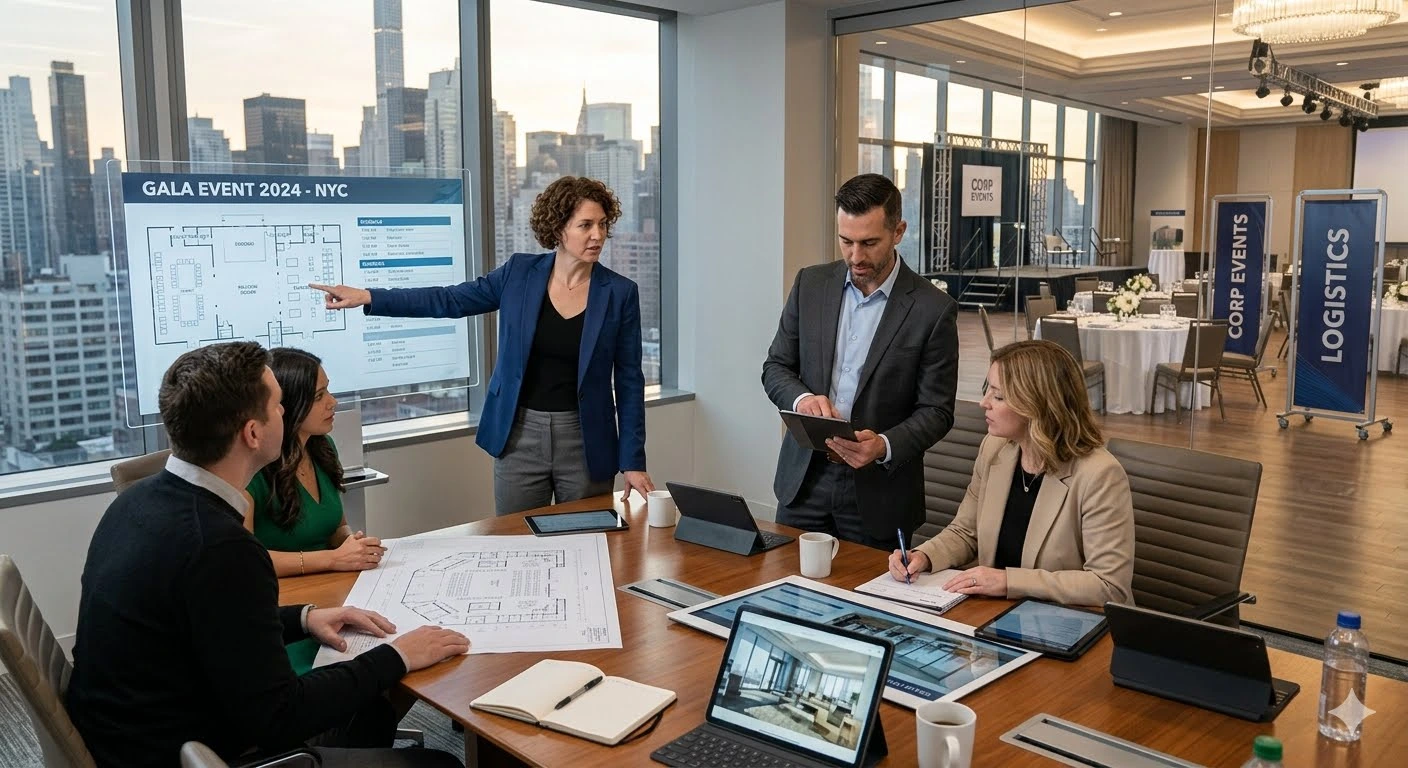
Every event a corporate event planner manages starts with a strategy conversation, not a venue search. Before any logistics are touched, the planner works with key stakeholders to establish what the event is designed to accomplish. Is it to drive revenue? Build culture? Recognize achievement? Educate an audience? The answers to those questions determine everything that follows.
A skilled planner pushes back when objectives are vague. “We want people to feel inspired” is a starting point, not a strategy. A strong corporate event planner translates that into specific design decisions: the right speaker order, the right entertainment energy at the right moment, the right room setup to enable the kind of interactions that actually produce that feeling.
2. Budget Management and Vendor Negotiation
Budget management is one of the most technically demanding parts of what a corporate event planner does. They’re responsible for building a realistic budget from the ground up, tracking spend across dozens of line items, and protecting the overall investment from scope creep, last minute additions, and vendor overruns.
Experienced planners know where the real money goes, and where costs are inflated. AV markups from venue exclusive vendors are a common trap. An experienced corporate event planner knows how to negotiate around exclusivity clauses, bring in preferred vendors, and make budget decisions that protect quality while preventing overspend. According to MPI research, budget management is consistently ranked as one of the top skill gaps in the event planning profession, which is why experienced planners who do it well command serious market value.
3. Venue Selection and Contract Management
Venue selection is far more complex than finding a room that fits the expected headcount. A corporate event planner evaluates venues on acoustics, natural lighting, breakout space configuration, loading dock access, AV infrastructure, catering flexibility, parking, accessibility, and proximity to lodging, all against the specific requirements of the event program.
Beyond the site visit, the planner manages contract negotiations that protect the client: attrition clauses, force majeure terms, cancellation policies, and exclusivity restrictions. A single unreviewed contract clause can cost tens of thousands of dollars. The corporate event planner‘s job is to make sure it never does.
A site visit is also where a skilled planner catches what a floor plan can’t show: a loading dock that can’t fit the AV truck, a ballroom that splits awkwardly when the divider wall goes up, or a WiFi network that can’t handle 300 devices on a conference app. They walk the space at the time of day the event will actually run, checking natural light angles, ambient noise from adjacent rooms, and elevator capacity during a hard changeover. That on site diligence, not just the contract terms, is what separates a venue selection that holds up on event day from one that creates a scramble.
4. Vendor Sourcing and Relationship Management
A corporate event planner doesn’t just find vendors, they build a network of trusted partners whose work they can vouch for in high stakes environments. AV companies, catering teams, decor vendors, transportation providers, photographers, and entertainment professionals all need to be sourced, vetted, contracted, and coordinated as a single production team.
For entertainment specifically, a strong planner understands the difference between a vendor who works events and a vendor who works corporate events. The skill sets are different. The stakes are different. A professional corporate entertainment team who reads the room, adjusts in real time, and protects the brand is worth more than a cheaper option who delivers a generic performance and leaves. The planner’s job is to know the difference before the contract is signed.
5. Program Design and Run of Show Development
The run of show is the operating document that governs everything that happens on event day, minute by minute. Building it is one of the most precise responsibilities of a corporate event planner. It accounts for speaker transitions, AV cues, catering timing, entertainment segments, award presentations, networking breaks, and every handoff between program elements.
A well built run of show isn’t just a schedule, it’s a communication document for every vendor and stakeholder on site. When the keynote runs three minutes long, the planner’s run of show tells the AV team, the catering crew, and the entertainment partner exactly how to absorb that time without the audience ever noticing the adjustment.
6. On Site Coordination and Real Time Problem Solving
Event day is where a corporate event planner earns their fee. The best planners make event day look effortless, which is only possible because they’ve anticipated failure points and built contingencies for each one. On site, they’re managing vendor arrivals, directing setup, running pre event walkthroughs, briefing speakers, and coordinating with venue staff, all simultaneously.
Real time problem solving is the most underrated part of what a corporate event planner does. When the keynote speaker’s flight is delayed, a microphone cuts out mid presentation, or a catering delivery arrives short, the planner absorbs that problem and resolves it before it reaches the attendee experience. The audience never knows. That invisibility is the benchmark of elite event planning execution.
7. Post Event Analysis and Reporting
After the event ends, a corporate event planner isn’t done. Post event analysis closes the loop on every objective that was set at the start. Attendee satisfaction surveys, budget reconciliation, vendor performance reviews, ROI calculations, and stakeholder debrief sessions are all part of the planner’s responsibility.
This phase is where the strategic value of a great planner becomes most visible. The insights generated from one event’s post analysis directly improve the design of the next. Organizations that invest in this process, and partner with planners who take it seriously, build a compounding advantage in their events program over time. According to EventMarketer, brands that measure event ROI rigorously outperform those that don’t by a significant margin across retention and conversion metrics.
The Skills That Separate a Good Corporate Event Planner from a Great One
Technical competency, budget management, contract negotiation, logistics coordination, is the baseline for any corporate event planner. The differentiators are softer, harder to teach, and more directly correlated with event outcomes.
Anticipatory thinking. The best planners don’t react to problems, they predict them. They’ve run enough events to know that the venue will underestimate setup time, that the VIP speaker will need something that wasn’t in the rider, and that the networking break will run long. Their contingencies are already in the run of show before any of those things happen.
Communication across stakeholder levels. A corporate event planner operates at the intersection of executive leadership, operational teams, external vendors, and event attendees. The ability to communicate the same information differently, with precision for an AV crew, with strategic framing for a C-suite, with warmth for an attendee, is a skill that separates planners who get re hired from those who don’t.
Energy management. An event’s energy has an arc. A skilled corporate event planner understands that arc and designs the program to ride it, building energy through the morning, sustaining it through an afternoon that would naturally dip, and closing in a way that sends people out feeling something. This is where the intersection of event planning and audience engagement strategy becomes most critical. It’s also where the right entertainment partner makes or breaks the experience.
Composure under pressure. Event day is high stakes, time compressed, and full of variables the planner can’t fully control. The ability to stay calm, make fast decisions with incomplete information, and never let the stress reach the client or the audience is a foundational trait of elite corporate event planners.
Types of Events a Corporate Event Planner Manages
The scope of what falls under the umbrella of “corporate events” is broader than most people realize. A corporate event planner may work across all of the following:
Annual conferences and conventions, Large scale multi day programs with keynote speakers, breakout sessions, networking events, and expo floors. These are complex productions that require 6 to 12 months of planning and coordination across dozens of vendors.
Sales kickoffs, High energy, high stakes programs designed to align and motivate a sales team at the start of a new year or quarter. Entertainment and engagement strategy are central to making these land. The wrong energy in the room kills momentum; the right energy can carry a team for months.
Award galas and recognition events, Formal programs that celebrate achievement. A skilled corporate event planner understands the emotional arc of these events and designs every element, from the cocktail hour music to the award presentation format, to honor the people being recognized.
Product launches, Experiential events designed to generate excitement, media coverage, and audience buy in around a new product or service. These events demand a seamless blend of brand strategy, production design, and live experience.
Executive retreats, Intimate leadership programs focused on strategy alignment, team development, or relationship building. These require a different approach than large scale events, more flexibility, more personalization, and a deeper understanding of the leadership culture.
Employee appreciation events, Programs designed to recognize and retain talent. A great corporate event planner understands that these events carry significant cultural weight and that a poorly executed appreciation event can do more damage than not having one at all.
When Should You Hire a Corporate Event Planner?
The honest answer: earlier than you think. Most organizations bring in a corporate event planner too late, after the venue is booked, the budget is half committed, and the strategic framing of the event has already been decided by people who won’t be responsible for executing it.
Here are the indicators that you need a professional planner:
The event has 100+ attendees. At this scale, the logistics complexity, vendor coordination requirements, and risk surface area exceed what an internal team can manage alongside their regular responsibilities without something falling through.
The stakes are high. If a poor attendee experience would damage client relationships, harm employee morale, or reflect on leadership, the event warrants professional planning. This is not a cost line, it’s risk management.
The program has multiple moving parts. Multiple speakers, a dinner service, an awards segment, entertainment, and a networking reception, that’s a production, not an event. A corporate event planner is the person who makes all of those elements work together as a single cohesive experience.
You’re trying to achieve a specific business outcome. If you need attendees to leave feeling energized, aligned, or ready to act, that outcome needs to be designed in, not hoped for. A skilled planner makes it happen by design.
How Corporate Event Planners Work With Entertainment Partners
One of the most important vendor relationships a corporate event planner manages is with their entertainment partner. This is the person, or team, responsible for controlling the energy of the room at the moments that matter most: the opening, the transitions, the dinner, the post awards celebration.
Great entertainment partnerships start early. A corporate event planner who brings in their entertainment team at the beginning of the planning process, rather than as a last minute add on, gets a collaborator who can shape the energy arc of the entire program, not just fill a 90 minute slot.
At No Stress Zone Entertainment, we work directly with corporate event planners as a production partner, not just a vendor. That means we’re in the run of show conversation from the beginning, we’re aligned on objectives before event day, and we’re reading the room in real time to adjust before a dip becomes a problem. If you’re planning a corporate event and want an entertainment partner who operates at that level, let’s talk.
Frequently Asked Questions About Corporate Event Planners
What is the difference between an event planner and a corporate event planner?
A general event planner may work across social, nonprofit, and corporate events. A corporate event planner specializes in the business context, understanding brand standards, stakeholder dynamics, ROI measurement, and the specific pressure of events where business relationships are at stake. The skill sets overlap, but the experience and orientation are different.
How much does a corporate event planner cost?
Fees vary widely based on event scale, scope, and the planner’s experience level. Independent planners may charge flat project fees ranging from a few thousand dollars for smaller events to $50,000+ for large scale conferences. Many work on a percentage of budget model (typically 10 to 20%). In house corporate event planners are salaried employees, often in the $60,000 to $120,000 range depending on market and experience.
What qualifications should a corporate event planner have?
Industry certifications like the Certified Meeting Professional (CMP) designation signal professional credibility. However, the most important qualification is relevant experience, specifically, experience managing events at the scale and type you’re planning. Ask for references from comparable corporate events, not general testimonials.
How far in advance should we hire a corporate event planner?
For large conferences or multi day events, 9 to 12 months is standard. For midsize corporate events (500+ attendees), 6 months minimum. For smaller events (under 200 attendees), 3 to 4 months is workable, though earlier is always better. The most qualified corporate event planners book quickly, waiting until 60 days out often means settling for whoever is available rather than whoever is best.
What questions should we ask when hiring a corporate event planner?
Ask about their experience with events of your specific type and scale. Ask how they handle day of changes. Ask for references from corporate clients specifically. Ask how they measure success. And ask what their planning process looks like from intake through execution, a professional corporate event planner will have a clear, structured answer that tells you exactly what to expect at every stage.
Two things separate a planner who checks boxes from one who builds something people remember: a real corporate event planning strategy behind every decision, and an eye for the experiential marketing event examples that turn a standard program into a moment worth talking about.
The Bottom Line: What a Corporate Event Planner Actually Delivers
A corporate event planner delivers two things: a flawless execution and a protected investment. The execution side, the logistics, the timing, the vendor coordination, is visible. The protected investment side is less visible but equally important. Every contract reviewed, every risk anticipated, every vendor relationship leveraged means the organization gets more event for its budget and fewer surprises on event day.
The best corporate event planners make themselves invisible during the event itself. The attendees don’t see them working, they only experience the result: a room that feels right, a program that flows, an evening that lands exactly as intended. That invisibility is the mark of craft. And it’s why organizations that have worked with a truly skilled corporate event planner rarely go back to doing it any other way.
If you’re building an event where the experience matters, where the room needs to feel something specific, move in a specific direction, and leave with a specific impression, we’d love to be part of the team that makes it happen. Reach out to No Stress Zone Entertainment and let’s talk about what your event needs.