Conference session overlap is the design failure attendees complain about but organizers rarely fix. When two sessions attendees want to attend land in the same time slot, attendees leave feeling like they missed something regardless of which choice they made. That is conference session overlap creating attendee FOMO by design.
Here are the five best ways producers reduce conference session overlap without cutting programming variety.
Table of Contents
- Fix 1: Track Attendee Interest Signals
- Fix 2: Repeat High Demand Sessions
- Fix 3: Record and Publish On Demand
- Fix 4: Design Track Complementarity
- Fix 5: Communicate Trade Offs Clearly
Fix 1: Track Attendee Interest Signals Before Programming
Conference session overlap gets designed into the run of show when programrs do not have real interest data from attendees. Sessions get scheduled based on speaker availability instead of audience demand.
Fix this by capturing interest signals during registration. Ask attendees to rank their top five topics. Ask them to identify sessions they would prioritize. That data drives programming decisions and reduces overlap on the topics that actually matter to your audience.
The two highest interest sessions should never share a time slot. Ever. Session overlap on the two most demanded topics is the fastest way to generate attendee frustration.
Interest signals also help you identify which sessions can safely share a time slot. Low overlap in stated interest between two sessions means running them in parallel is safe. High overlap means one should move.
Fix 2: Repeat High Demand Sessions Later in the Program
Session repeats are the single most underutilized tool against conference session overlap pain. When two high demand sessions must share a time slot, repeat both later in the day or on day two.
The repeat schedule needs to be communicated at registration and in the mobile app. Attendees who miss session A because they chose session B during the overlap window can still catch session A in the repeat.
Session repeats also help speakers refine their content. The second delivery is often sharper than the first because they have absorbed feedback and questions from the initial audience. Attendees at the repeat get a better session than attendees at the original.
Repeats cost you additional room and speaker time but that cost is small compared to the attendee satisfaction impact. Overlap frustration is one of the biggest drivers of low renewal rates.
Fix 3: Record Every Session and Publish On Demand

On demand recordings solve conference session overlap after the fact. Attendees who missed a session because of overlap can watch the recording within 48 hours of the event.
The recording quality needs to be professional. Bad audio, single fixed camera angle, no slides captured, kills the on demand value. Every session should have real production support for the recording to matter as an overlap fix.
Post event survey data consistently shows that access to on demand recordings raises attendee satisfaction by 15 to 25 percent even when attendees do not actually watch all the sessions they missed. The optionality matters as much as the actual usage.
Time gating on demand access also works. Free access for 90 days post event. Then charge a modest fee for continued access or bundle recordings into next year’s registration. Overlap becomes a soft revenue lever instead of pure cost center.
Fix 4: Design Track Complementarity Not Redundancy
Conference session overlap that hurts the most is when parallel tracks cover related topics. Attendees who care about marketing analytics have to choose between two sessions on marketing analytics. That is unforced design error.
Design tracks to complement, not compete. If one track is deep on marketing analytics, the parallel track should cover product analytics or sales analytics. Different enough that attendees can attend either without missing the core interest.
Complementary track design also lets attendees mix and match. Someone can go deep on their primary interest track for morning sessions and pivot to a secondary interest for afternoon sessions. Overlap disappears because the tracks are not fighting each other.
Track descriptions need to reflect the complementarity clearly in the program guide. Attendees who see redundant sounding track names will not trust that the parallel programming is not overlapping.
Fix 5: Communicate Trade Offs Clearly in Advance
Even the best designed programs will have some conference session overlap. Communicate the trade offs clearly and attendees plan around them instead of feeling ambushed on show day.
The mobile app should flag overlap for each attendee based on their session choices. Send them a pre event summary. “You have selected sessions A, B, and C. Session D is popular with people who like your other choices. Session D conflicts with session B.”
That advance visibility lets attendees make decisions with time to think. It also surfaces which overlap decisions are highest stakes for your audience so you can prioritize repeats or on demand publishing for those.
Post event surveys should also ask specifically about overlap frustration. Which sessions did attendees miss because of overlap. That data drives programming decisions for next year and communicates that you are listening.
How Attendees Actually Choose During Session Overlap
Understanding attendee decision making during conference session overlap moments helps you design better parallel programming.
Attendees usually pick the session with the more prominent speaker regardless of topic relevance. That means big name speakers create the highest overlap losses because the parallel session is under attended and its speakers feel disrespected.
Attendees also pick based on social proof. If they see peers walking toward one session, they follow. Overlap outcomes get compounded by herd behavior once the sessions start.
Finally, attendees pick based on venue proximity. If two sessions are on different floors, the one closer to the last general session wins. Physical layout is a subtle but powerful driver of overlap outcomes.
A regional sales conference saw this pattern directly in its post event data. A session led by a first time internal speaker on a genuinely useful topic drew barely a third of the room, while a returning keynote name pulling from a lighter topic packed the space next door. The lighter session was not more valuable to attendees, it was simply less risky to choose. Producers who understand that speaker recognition outweighs topic relevance in the moment can counter it by giving newer speakers a visibility boost in the app and program guide before the conference session overlap decision actually happens.
Programming Failures That Amplify Conference Session Overlap Pain
Five programming decisions amplify conference session overlap pain. Producers who avoid these preserve attendee satisfaction even in overlap heavy programs.
Failure one is packing marquee speakers into the same time slot to reduce total program hours. That decision saves an hour of programming but generates hours of attendee frustration.
Failure two is not tagging sessions by topic depth. Introductory sessions and advanced sessions on the same topic should not run at the same time. Attendees at different experience levels need different content.
Failure three is ignoring sponsor sessions in overlap calculations. Sponsor sessions often lose to peer content sessions in the same slot. Design around this reality instead of pretending it does not exist.
Failure four is not accommodating international attendees whose time slot preferences differ. Overlap for global attendees can effectively double if the popular sessions land during their least energetic hours.
Failure five is not publishing the full program early enough. Attendees who see the full agenda four to six weeks out can plan around overlap. Last minute agenda releases create panic and reduce satisfaction.
Measuring Conference Session Overlap Impact
Post event surveys should ask three specific questions about overlap. Which sessions did attendees skip because of overlap. How disappointed were they on a 1 to 10 scale. Would they have preferred repeats, on demand, or a different schedule.
The scale question is the leading indicator. Disappointment scores above 6 signal overlap is materially hurting your attendee experience. Below 4 signals overlap is manageable and can be tolerated.
Track these three metrics across events. Year over year improvement in overlap satisfaction becomes a real signal to your board that programming decisions are working.
A benchmark worth tracking alongside the disappointment score is the percentage of attendees who report skipping a session specifically because of a scheduling conflict, not lack of interest. Conferences that keep that number under 15 percent are typically running well designed grids with enough repeats and on demand coverage to absorb the inevitable overlap. Numbers climbing toward 30 percent or higher usually point to a conference session overlap problem in the schedule itself, rather than a content problem, and that distinction changes what actually gets fixed before the next event.
For related session design context, see Conference Attendee Engagement | Audience & Event Energy and Interactive Conference Ideas That People Actually Join.
Vendor Session Design and Conference Session Overlap
Vendor and sponsor sessions add complexity to conference session overlap decisions. Sponsors pay for their session slots and want peak visibility. Attendees rank sponsor content lower than peer content in most cases.
Give sponsor sessions their own track that runs during scheduled peer session breaks. That way sponsor sessions do not compete with peer content and sponsor attendance stays predictable.
The sponsor track approach also lets you sell sponsor sessions on a value proposition that includes protected attendance windows. Sponsors renew when their session attendance holds year over year. That renewal math depends on smart placement.
A software company sponsoring a mid morning slot at a mid size conference ran into exactly this dynamic. Their session got scheduled opposite a well known industry speaker, and attendance came in under twenty people in a room built for eighty. The fix the following year was simple: move the sponsor track into a dedicated window between the morning keynote and the first breakout block, when no peer content is competing for attention. Attendance tripled without changing the sponsor’s content or budget, because the conference session overlap that had been quietly killing their numbers was gone.
Special Interest Group Sessions and Overlap Strategy
Special interest groups like women in industry, emerging leaders, or regional cohorts add another layer to conference session overlap planning. These groups often have dedicated meetings that should not compete with the main program.
Schedule SIG meetings during breakfasts or early morning windows before general sessions start. That placement respects the SIG time commitment without forcing attendees to choose between community and content.
SIG leaders should also be involved in overall programming decisions. They know which sessions their members will prioritize and can flag conference session overlap concerns before the schedule is finalized.
Community driven programming decisions consistently outperform top down programming decisions for attendee satisfaction. SIG involvement is one of the highest leverage moves in reducing perceived overlap frustration.
Room Size Planning and Conference Session Overlap
Room capacity mismatch worsens the impact of conference session overlap. When a popular session lands in an undersized room while a competing session runs in a large room, attendees who lost the overlap decision face additional frustration finding a seat.
Match room size to expected demand based on interest signals from registration. High interest sessions belong in your largest rooms. Low interest sessions belong in smaller intimate spaces where the smaller crowd feels engaged rather than sparse.
Room switching between sessions can also reduce conference session overlap friction. A session that was expected to have low demand but exceeded expectations should move rooms for the second delivery instead of being repeated in the same undersized space.
One mid size association conference learned this the hard way when a last minute keynote addition drew triple the registered interest of the session it replaced, but the room assignment never changed. Attendees stood in the hallway for a session that technically had a seat waiting two floors up, in a room sized for the original, lower demand topic. The fix was not more rooms. It was matching room capacity to actual registered interest before the schedule locks, the same interest signal data that prevents conference session overlap on the content side in the first place.
The Bottom Line on Conference Session Overlap
Conference session overlap is a design decision, not an inevitability. Producers who take conference session overlap seriously build repeat attendance because attendees trust the programming quality.
The five fixes above are how mature programs manage overlap without cutting programming variety. Track interest signals. Repeat high demand sessions. Record on demand. Design complementary tracks. Communicate trade offs clearly.
According to the International Association of Exhibitions and Events, programming design quality is now the number one factor cited in attendee rebooking decisions. That elevation means conference session overlap deserves executive attention, not just operational planning.
Reach out at Corporate Event DJ Contact DJ Reese | Trusted Expert 500+ for a programming review before your next conference finalizes.
Building the Grid Before the Agenda Locks
Session overlap almost always traces back to building the agenda in a linear list before mapping it against a visual grid. When breakout sessions get added one at a time to a spreadsheet, it’s easy to lose track of how many rooms, AV setups, and staff a given time slot actually requires, until the grid reveals five sessions competing for the same resources at 2:00 PM. Build the time and room grid first, then populate sessions into open slots. Not the other way around.
The grid also needs to account for transition time between sessions, not just the sessions themselves. A 50 minute session followed immediately by another 50 minute session in a different room, with no gap, guarantees late arrivals and disrupted starts as attendees physically move between spaces. Ten to fifteen minutes of dedicated transition time between concurrent blocks, built into the grid from the start, does more to fix perceived “session overlap” complaints than adding more rooms ever does.
Once the grid is locked, stress test it against your highest demand sessions specifically. If your keynote speaker is also running a smaller breakout later in the day, or if two of your most popular topics are scheduled in the same time block, that’s a signal worth catching in planning rather than hearing about from frustrated attendees who had to choose between two sessions they both wanted. A quick survey of registered attendees’ top session picks before the agenda locks can flag these conflicts while they’re still cheap to fix.
Communicating Session Changes Once the Agenda Is Live
Even a carefully built grid sometimes needs last minute adjustment, whether it’s a speaker cancellation, a room capacity issue, or an unexpected scheduling conflict discovered after the agenda has already gone out to attendees. How that change gets communicated matters as much as the change itself. A session move buried in a small update on the event app, with no direct notification, guarantees a wave of confused attendees showing up to the wrong room at the original time.
The events that handle live agenda changes smoothly use multiple simultaneous channels for anything that affects where or when attendees need to be, meaning app push notification, signage at the original room directing people to the new location, and a mention from stage if the change happens during the event itself. Redundancy in how the change is communicated costs little and prevents the frustration of attendees who missed a session simply because they didn’t see one specific notification.
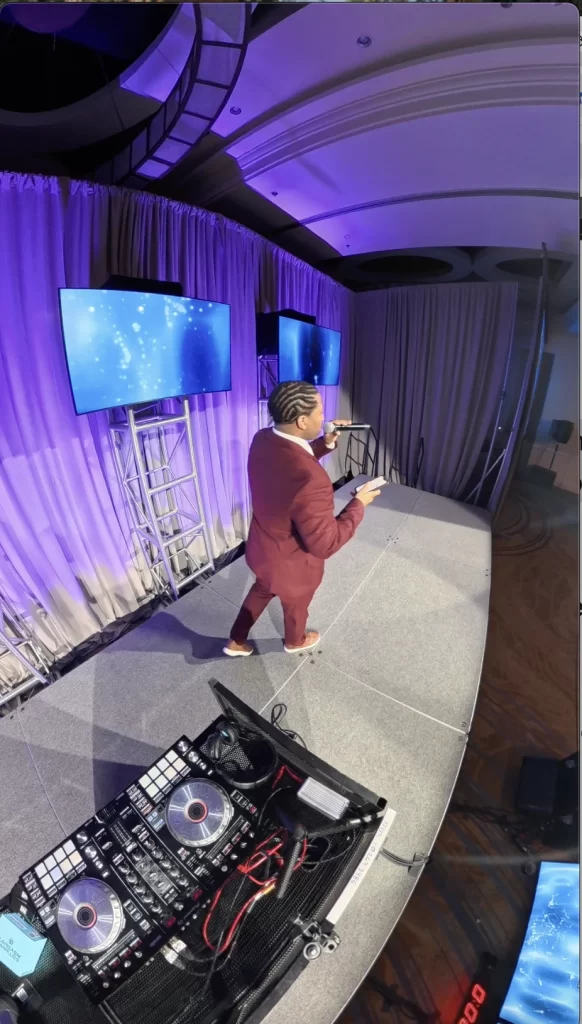
Proof from the room: see how we ran the mic all day at the Alliance for Science East Coast Conference.
Frequently Asked Questions
How do you reduce conference session overlap on popular topics?
Capture interest signals during registration, ask attendees to rank their top five topics, and use that data to program the schedule. The two highest interest sessions should never share a time slot; overlap on the two most demanded topics is the fastest way to generate attendee frustration.
What causes conference session overlap in the first place?
Sessions get scheduled around speaker availability instead of real audience demand data, which is why interest signals captured at registration matter more than filling slots by convenience.