


The Complete Guide to Interactive Conference Ideas That Actually Work in 2026
The best interactive conference ideas we have seen deployed over twenty years of live event production weren’t found on a listicle. They were discovered in rooms where something went wrong, or something went right, and a decision was made in real time about how to respond.
After hosting corporate galas, sales kickoffs, and conference programs where event failure genuinely wasn’t an option, we have watched the same patterns repeat. Planners who master the logistics but miss the experience. Events that check every box on the run of show and still leave attendees cold. Rooms that should feel electric and settle for fine.
This guide is about the difference. Not the mechanics of planning, there are a hundred checklists for that. This is about interactive conference ideas: what it actually takes to make a room feel the way you want it to feel, what most people get wrong, and how to do it right in 2026.
Table of Contents
- Why Interactive Conference Ideas Matter More Than Most Planners Realize
- The Framework Behind Effective Interactive Conference Ideas
- Interactive Conference Ideas for Energy Architecture
- Interactive Conference Ideas That Work in Real Time Execution
- Interactive Conference Ideas for Transition Moments
- Interactive Conference Ideas for Managing the Energy Dip
- How to Brief Your Vendors on Interactive Conference Ideas
- Common Mistakes That Undermine Interactive Conference Ideas
- Your Interactive Conference Ideas Action Plan for 2026
Why Interactive Conference Ideas Matter More Than Most Planners Realize
The business case for taking interactive conference ideas seriously isn’t soft. It’s directly tied to event ROI, repeat attendance, sponsor satisfaction, and whether decision makers approve next year’s budget.
Here’s what twenty years of production experience, and the research behind it, consistently shows: attendees remember experiences, not content. Ask someone what they got from a conference six months later, and they’ll describe how the room felt. The speaker who made them lean forward. The session that was paced perfectly. The moment nobody expected. They will not quote the keynote verbatim. They will not recall the full agenda. They will remember the feeling.
According to PCMA’s Convening Leaders research, the conferences attendees rate highest on experience, not just content, are the ones they return to and recommend. That data point alone makes interactive conference ideas one of the highest leverage investments a planner can make. Not a nice to have. Infrastructure.
Interactive conference ideas are about engineering that feeling intentionally. Not leaving it to chance, not hoping the speaker is charismatic enough to carry the room, not scheduling a networking break and calling it engagement. Designing the experience, the arc, the pacing, the moments that compound, so the feeling you want your attendees to walk away with is the one they actually get.
The planners who understand this treat interactive conference ideas as a strategic discipline. The ones who don’t end up producing events that are technically fine and experientially forgettable.
The Framework Behind Effective Interactive Conference Ideas
The mistake most planners make with interactive conference ideas is skipping straight to tactics, “let’s add a live poll,” “let’s do a networking speed round”, without a framework to hold those tactics together. Tactics without a framework are random acts of engagement. They might work. They might not. And you won’t know why either way.
Three pillars support effective interactive conference ideas. The mistake is skipping to pillar two before pillar one is solid.
Pillar 1: Energy Architecture. This is how the event is designed from an emotional standpoint, the arc, the pacing, the intentional highs and the recovery moments built between them. Energy architecture is set in the planning phase. It cannot be fixed on the day. Interactive conference ideas that don’t account for energy architecture feel like a collection of good sessions rather than a coherent experience.
Pillar 2: Real Time Execution. The ability to read the room and adjust is what separates a great event from a well planned one. This requires building flexibility into your program, briefing your vendors on the emotional objectives, not just the logistics, and ensuring someone in the room has decision making authority when the situation changes. The best interactive conference ideas only work if the team executing them can adapt.
Pillar 3: Measurement and Iteration. You can’t improve what you don’t track. But the right signals for interactive conference ideas aren’t the standard satisfaction scores, those measure whether the event was acceptable, not whether it was memorable. The qualitative indicators that tell you whether the experience landed are things like: “It flew by,” “we didn’t want it to end,” and “we have already told three people about this.” Track those.
Interactive Conference Ideas for Energy Architecture
Energy architecture is the foundation of every other interactive conference idea on this list. Without it, the tactics are decoration. With it, every tactic compounds.
Design the emotional arc before you design the agenda. The most effective interactive conference ideas we have seen implemented all started with a question: what do we want people to feel at the beginning, the middle, and the end? The agenda was then built to serve that emotional arc, not the other way around.
A corporate sales kickoff, for example, should feel different at 9am (energy, momentum, this year is different) than at 11am (informed, equipped, capability) than at 5pm (connected, committed, ready). Interactive conference ideas that are mapped to these emotional states are the ones that work.
Plan the walk in with the same care as the keynote. The five minutes before your program starts set the tone for everything. The music playing in the room, the lighting, the temperature, the way people are greeted, these are all pre frames that tell your audience what kind of experience they’re about to have.
One of the most underrated interactive conference ideas is controlling the walk in music with intention. Not background filler. A specifically programd sequence that builds energy toward the moment your program begins, so that when you hit play on the opening, the room is already in motion. A corporate event DJ who understands this is managing energy from the moment the first attendee walks through the door.
Build in recovery moments. Interactive conference ideas aren’t only about building energy. They’re about managing it sustainably across an eight hour day. Recovery moments, a well placed break, a change of format, a moment of humor that releases tension, are as important as the peaks. Leave them out and the energy doesn’t maintain. It crashes.
Interactive Conference Ideas That Work in Real Time Execution
The best interactive conference ideas are designed in advance but executed in real time. Here’s how to set your team up to actually deliver on what you planned.
Brief your emcee on emotional objectives, not just the schedule. The emcee is the energy manager of your event. They’re the one person in the room whose job is to hold the experience together, to read what’s happening with the audience and adjust before a problem becomes visible. The most effective interactive conference ideas require an emcee who knows the emotional arc, not just the run of show.
Brief your host on: what energy state you need the room in at each transition point, where the natural dip points are and what the plan is for managing them, and what permission they have to go off script if the room needs it. An emcee who only knows the agenda can execute the plan. An emcee who understands the objective can save the event.
Give your host the authority to act. This is one of the most practical interactive conference ideas on this list and one of the most underused. The emcee needs explicit permission, in advance, not in the moment, to adjust timing, change tone, extend a segment that’s working or cut one that isn’t, and add unscripted moments when the room calls for it. A great host reads the room in real time. But only if you’ve given them the latitude to act on what they see.
Build flex into the program. No event runs perfectly on paper. The best interactive conference ideas account for this by building intentional flexibility, a session that can expand if the conversation is alive, a transition that can contract if energy needs to move. Rigid programming is the enemy of responsive execution.
Interactive Conference Ideas for Transition Moments
The space between sessions is where most events lose the energy they worked to build. A well designed two minute transition compounds the momentum of what just happened. A dead two minute transition drains it. Interactive conference ideas that focus specifically on transition management often produce the biggest ROI of any investment in the day.
Never leave the room in silence between segments. Silence at a conference signals “nothing is happening.” Music, specifically chosen for the moment, signals “we’re still moving.” This sounds simple, but most events underinvest here. Interactive conference ideas for transitions include: a music bridge that matches and then shifts the energy, a brief visual element that previews what’s next, or a host line that closes what just happened before opening what’s coming.
Use the transition as a setup. One of the best interactive conference ideas for experienced planners is treating every transition as a mini architecture moment. The thirty seconds before a speaker takes the stage can make or break their opening. A well built intro that ends on a peak of energy gives the speaker a room that’s already leaning in. A flat intro gives them a room they have to warm up themselves.
For conference and summit events where the speaker lineup is the core content, transition management is the difference between a program that flows and one that fragments. These interactive conference ideas are about the architecture around your content, not the content itself.
Design the post lunch re entry. The transition back from lunch is one of the most important, and most neglected, moments in any conference. The room energy is typically at its lowest point of the day. Interactive conference ideas for the post lunch re entry include: a higher energy music program as people walk back in, an emcee segment that re engages the room before handing it to the next speaker, or a short interactive element that gets people physically and mentally back in the room before the next session begins.
Interactive Conference Ideas for Managing the Energy Dip
Every event has one. The post lunch slot. The 3:45pm breakout. The moment before dinner when people don’t know where to stand or what to do. These are predictable. The best interactive conference ideas treat them as design problems, not logistics problems.
Identify the dip in advance. Before your event, map the energy arc alongside the agenda and mark the predictable low points. Then ask: what’s currently scheduled at that moment, and is it designed to address the dip, or to compound it? Most conference programs have their heaviest content sessions scheduled right at the natural energy low. That’s not a content problem. It’s an architecture problem.
Counter program the dip. Interactive conference ideas for the low energy windows include: a high energy format change (panel instead of lecture, activity instead of presentation), a musical energy injection before the session starts, a host moment that re engages the room, or a intentional break that gives people real recovery time rather than five minutes standing in a hallway.
Use recognition strategically. One of the most underused interactive conference ideas for managing the mid afternoon energy dip is a recognition or awards moment. Done well, a recognition segment gives people something to feel, and an audience that’s feeling something is an audience that’s engaged. Done wrong, it’s a procedural list read into a microphone. The difference is in the design.
For gala and awards events, this design element is the entire program. But the principles apply equally to internal conferences where team recognition is part of the agenda. Interactive conference ideas that create genuine celebration, not obligatory acknowledgment, are the ones that re energize a room.
How to Brief Your Vendors on Interactive Conference Ideas

Most vendors are briefed on logistics. The best interactive conference ideas require briefing vendors on experience objectives, and there’s a significant difference.
“Cocktail hour is from 6 to 7pm” is a logistics brief. “By 6:50, we need the room energized and socially active, people should be talking to people they didn’t come with, and the energy should feel like momentum building toward dinner, not people waiting for it to end” is an experience brief.
The second brief gives your DJ, your emcee, and your events team something to actually execute against. Interactive conference ideas only work if the vendors executing them understand the objective.
Brief your DJ on the emotional timeline. Your DJ at a corporate event isn’t a playlist. They’re an energy management tool. The interactive conference ideas that require DJ support, walk in music, cocktail hour energy management, closing energy, recognition underscores, all require a DJ who understands what emotional state you’re trying to create at each moment, not just what time each segment starts.
A professional corporate events team that treats the DJ as an experience partner, not a vendor who shows up and plays songs, will run circles around the team that doesn’t. This is one of the most impactful interactive conference ideas available to planners who are willing to invest in the briefing process.
Create an experience brief, not just a run of show. The run of show tells vendors what happens and when. The experience brief tells them what you’re trying to make the audience feel, and at what point. Sharing both is one of the simplest and most effective interactive conference ideas a planner can implement, and it costs nothing.
Common Mistakes That Undermine Interactive Conference Ideas
After twenty years of production, these are the patterns we see consistently undermine otherwise strong interactive conference ideas.
Mistake 1: Designing by agenda instead of emotional arc. The agenda is a logistics tool. The emotional arc is the experience design. Interactive conference ideas built only around the agenda produce technically correct events that feel emotionally flat.
Mistake 2: Treating entertainment as decoration. The DJ, the emcee, the entertainment, when these are treated as add ons rather than infrastructure, they can’t do their job. Interactive conference ideas that leverage entertainment effectively treat it as the energy management system of the event, not the party at the end.
Mistake 3: Not briefing vendors on the experience objective. This one costs planners points on every metric that matters, audience energy, attendee experience scores, sponsor satisfaction. Interactive conference ideas require vendors to know the objective, not just the logistics.
Mistake 4: Over programming. No recovery moments. No flex time. Back to back sessions with no breathing room. Interactive conference ideas can’t work in an over programd schedule because there’s no space for them to land. Audiences need a moment to process before they can absorb the next thing.
Mistake 5: Measuring success by logistics, not experience. “It started on time” and “we stayed on schedule” measure execution. “The room was electric,” “we didn’t want to leave,” and “we are already talking about it” measure experience. Interactive conference ideas should be evaluated by experience metrics, not logistics metrics.
Your Interactive Conference Ideas Action Plan for 2026
Here’s where to start with interactive conference ideas for your next event:
This week: Identify the highest risk energy moment in your next event, the post lunch slot, the late afternoon breakout, the transition to dinner. Ask what you’re currently doing at that moment and whether it’s designed or just scheduled. Most planners will find it’s just scheduled.
Before your next event: Map the emotional arc alongside the agenda. Write down what you want people to feel at the beginning, the middle, and the end. Then look at what’s scheduled at each of those moments and ask whether it’s designed to produce that feeling.
In your vendor briefings: Add an experience brief alongside your run of show. Give your DJ, your emcee, and your AV team the emotional objectives, not just the timing. These interactive conference ideas cost nothing extra to implement and compound the value of every vendor you’ve already hired.
After your next event: Ask the right questions. Not “did it start on time?” but “what did people say when they left?” Not “did we stay on budget?” but “are people talking about it?” The feedback that tells you whether your interactive conference ideas landed is qualitative, not quantitative.
If you’re planning a conference, sales kickoff, leadership summit, or corporate gala where the experience has to match the investment, where your audience, your leadership, or your sponsors expect something that actually works, No Stress Zone Entertainment is built for exactly this.
We don’t just show up and perform. We help you design how the room feels, and we adjust in real time before a dip becomes a problem. Interactive conference ideas are what we do, at every level, for events where failure genuinely isn’t an option.
No Stress Zone Entertainment designs audience engagement and event experiences for corporate events, conferences, and galas. Using music, professional hosting, and live event strategy, we control how a room feels and adjust in real time. Learn about our approach or start planning your event.
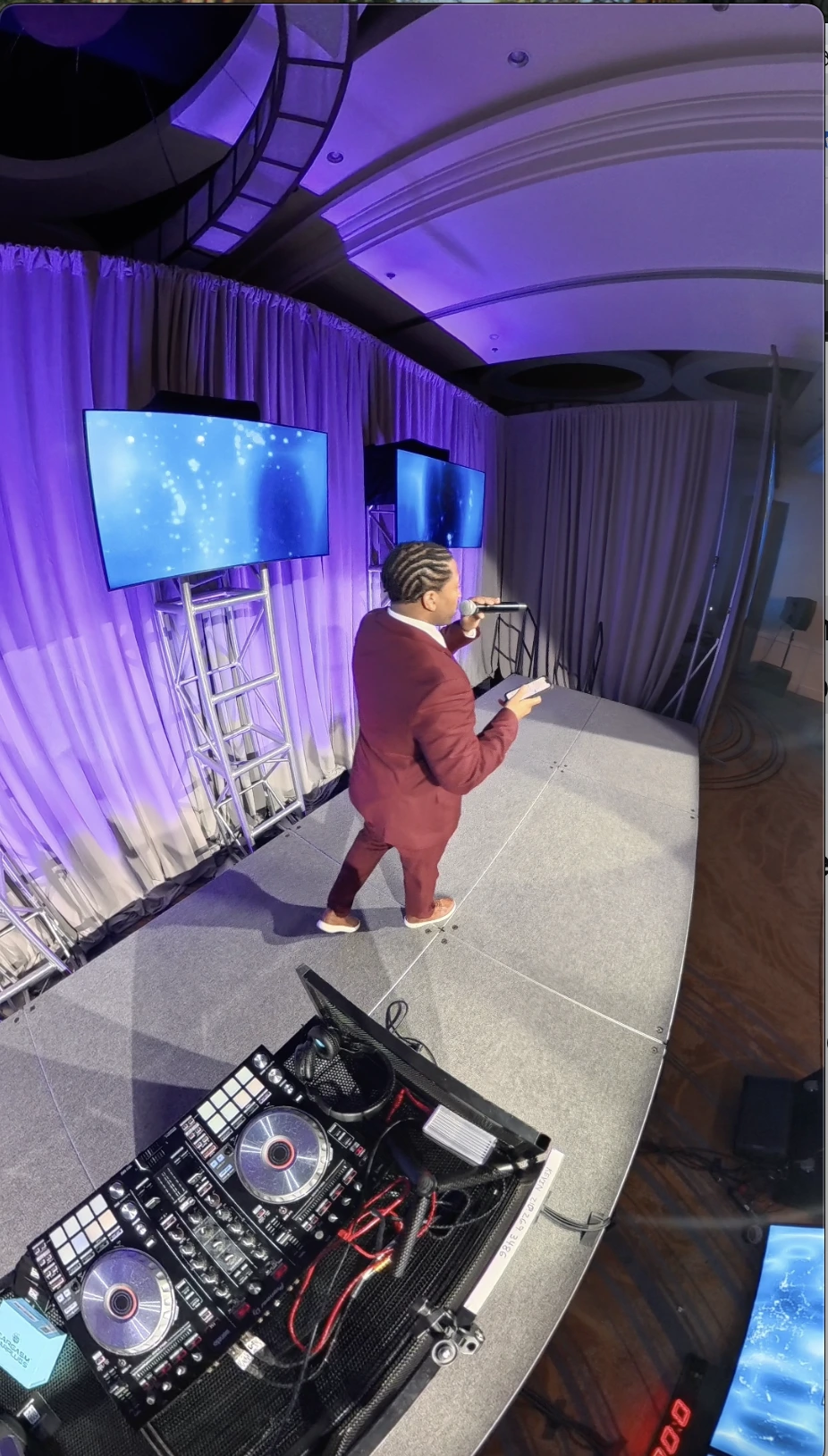
Proof from the room: see how we ran the mic all day at the Alliance for Science East Coast Conference.
Related Reading
Frequently Asked Questions
What’s the biggest mistake planners make with interactive conference ideas?
Mastering the logistics while missing the experience, events that check every box on the run of show but still leave attendees cold, and rooms that should feel electric but settle for fine.
Why do recovery moments matter in interactive conference ideas?
Energy has to be managed sustainably across a full day, not just built up. Recovery moments, a well placed break, a format change, a moment of humor, matter as much as the peaks; leave them out and energy crashes instead of holding steady.
How should you brief an emcee for an interactive conference?
Brief them on emotional objectives, not just the schedule. The emcee functions as the energy manager of the event, and knowing what the room needs to feel at each point matters more than a run of show timestamp.
Pingback: Conference Activities for Large Groups: What Actually Works in 2026 - DJ Reese | Corporate DJ & MC for Conventions & Sales Kickoffs
Pingback: What Corporate Event Planners Are Actually Asking — and What They Really Mean - DJ Reese | Corporate DJ & MC for Conventions & Sales Kickoffs