
FREE OPERATOR RESOURCE
Corporate Event DJ RFP Template
The 7 questions every planner should ask before signing
What You Get
This is the actual document real corporate event planners use before booking a DJ. Not marketing fluff. Not generic templates. The exact framework used at corporate conferences, sales kickoffs and brand activations.
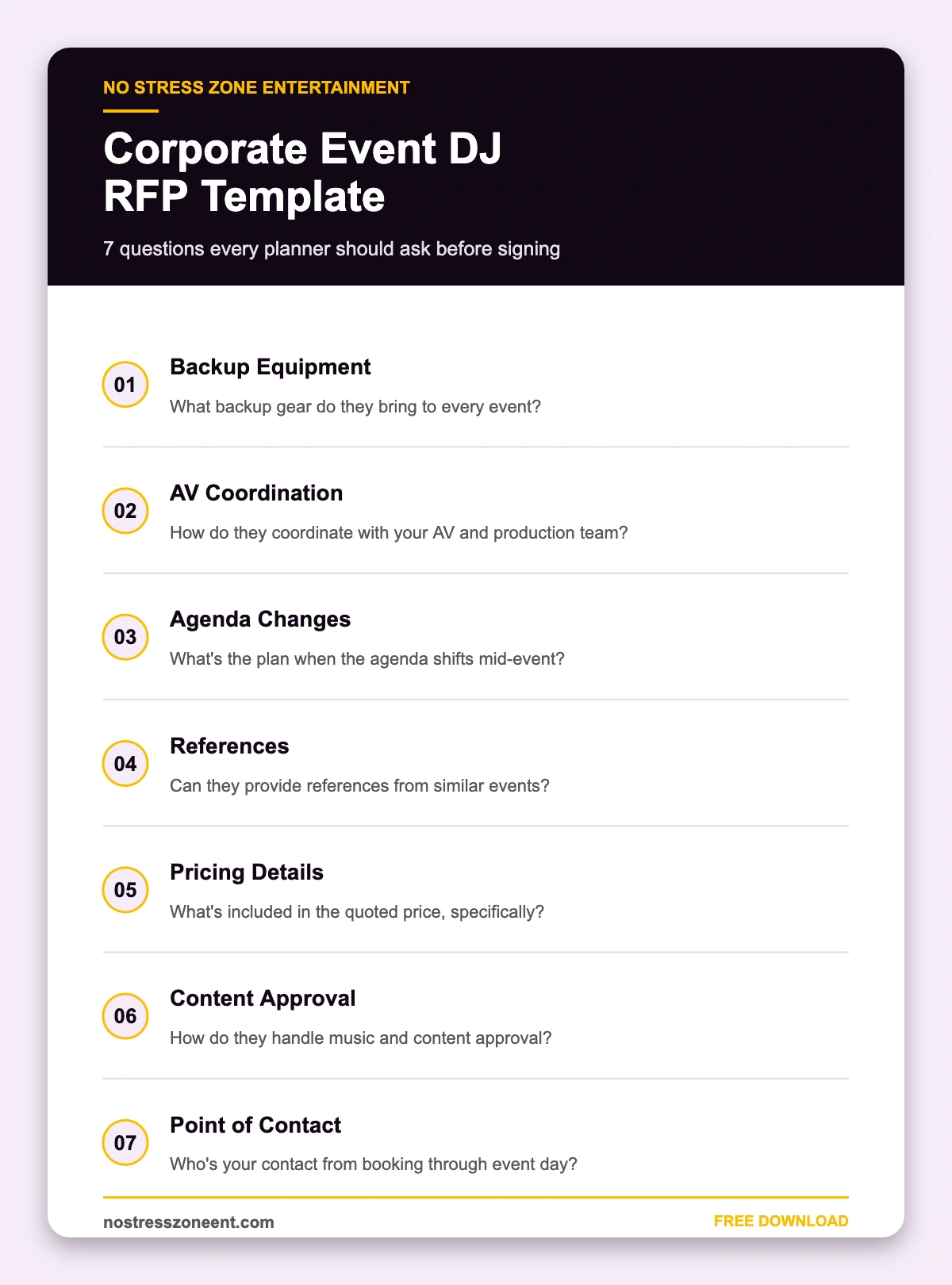
Inside the download
- Question 1: Backup Equipment
- Question 2: AV Coordination
- Question 3: Agenda Changes
- Question 4: References
- Question 5: Pricing Details
- Question 6: Content Approval
- Question 7: Point of Contact
Who This Is For
Corporate event planners. Sales operations leads. Marketing directors running annual events. Anyone about to hire a DJ for a professional program and unwilling to gamble on execution.
Why It Matters
Corporate events waste money on entertainment that does not deliver. The wrong booking costs more than the fee itself in sat score drops, sponsor pullback, and executive frustration.
This resource gives you the framework to make the right decision the first time. Use it. Save your program.
Download the Corporate Event DJ RFP Template
Enter your email below to get instant access.
Direct download link will be emailed to you and shown on the confirmation page.
About the Operator Behind This Resource

DJ Reese and the No Stress Zone Entertainment team have run corporate events for enterprise clients across pharma, tech, financial services, and enterprise sales kickoffs. Every resource we publish comes from real bookings, not theory.
Ready to Book?

Every corporate event we book runs through the same process. Discovery call, venue walk, rehearsal, run of show scoring, day of execution, post event debrief. No shortcuts.
Ready to talk? Contact No Stress Zone Entertainment and let’s map your next corporate event.
“DJ Reese is fantastic. He’s very easy to work with from booking through payment and execution. So much so that we have booked him for all of our remaining events in 2025.”
Why a Written RFP Template Changes the Outcome
Most corporate event DJ RFP template requests get skipped entirely, and that is exactly why so many bookings go sideways. When a planner sends a vague email instead of a structured RFP template, vendors respond with vague quotes, and the gaps only surface days before the event: no clarity on AV integration, no confirmation on backup equipment, no agreement on how the DJ handles run of show changes mid event.
A proper RFP template forces both sides to answer the same seven questions in writing before money changes hands. That single step eliminates the two most common failure points in corporate event DJ bookings: scope creep on game day and mismatched expectations about what “full production” actually includes.
For sales kickoffs, corporate conferences and brand activations specifically, the stakes are higher. A last minute vendor gap in front of 400 sales reps or a national medical team is a visible failure in front of the exact audience the event was built to energize. Planners who use this RFP template report fewer change order surprises and faster vendor comparisons, because every proposal comes back in the same format.
If you are evaluating multiple vendors for an upcoming sales kickoff, send this RFP template to every DJ or entertainment company on your shortlist before you take a single call. The vendors who answer cleanly and specifically are the ones worth a follow up conversation. Keep this RFP template on hand for every future vendor comparison too.
For a broader look at how structured procurement documents function across industries, this overview of the RFP process is a useful reference point, though the corporate event DJ RFP template above is built specifically around live entertainment procurement.
A Quick Gut Check Before You Send Your Next RFP
If you have ever booked a corporate DJ or entertainment vendor off a phone call and a handshake, you already know how this story ends. Ask for the RFP template answers in writing, every time, no exceptions. It takes the vendor ten extra minutes and it saves you from finding out about a gap on the actual event day.
What to Do the Moment the RFP Responses Come Back
Once every vendor has returned their RFP template answers, resist the urge to pick based on price alone. Lay the responses side by side and look specifically at how each vendor answers the questions about backup equipment and AV integration. Vague answers here are the clearest early warning sign of a rocky event day, regardless of how polished the proposal looks.
Planners running enterprise conferences and sales kickoffs at scale tend to keep a simple rule: if a vendor cannot answer all seven RFP template questions in writing within 48 hours, that response time is itself the answer. Corporate event production runs on tight timelines, and a vendor’s responsiveness during the RFP stage is a preview of their responsiveness during setup, changeovers, and the inevitable last minute schedule shift on event day. A well organized RFP template saves hours during multi vendor review calls.
Keep a copy of the completed RFP template with your signed contract. If a dispute comes up after the event about what was promised, having both documents on file protects everyone and keeps the conversation focused on facts instead of memory.
The 7 Questions, Explained
Every corporate event DJ RFP template should force a vendor to answer the same seven questions in writing. Here is why each one matters and what a strong answer actually looks like.
1. What backup equipment do you bring to every event?
A vendor with a real answer will name specific redundant gear: a second mixer, backup speakers, spare cabling, and a contingency plan for a power failure. A vague “we always come prepared” is not an answer, it is a hope.
2. How do you coordinate with our AV and production team?
Corporate events almost always involve multiple vendors: AV, staging, lighting, and catering, all working the same room on the same clock. Ask specifically how the DJ integrates with existing AV systems and who owns the technical rehearsal.
3. What happens if the agenda changes mid event?
Agendas shift. A keynote runs long, a award ceremony gets moved up, a networking hour gets cut short. The RFP template should ask how the vendor handles real time changes without losing the room’s energy.
4. Can you provide references from similar corporate events?
A sales kickoff for 400 reps is a different animal than a 50 person board dinner. Ask for references from events that match your size, format, and industry, not just any past client.
5. What is included in your quoted price, specifically?
Travel, setup and teardown time, overtime rates, and equipment insurance should all be spelled out in writing. This is the single most common source of budget disputes after the event.
6. How do you handle music and content approval?
Brand safe music and messaging matter more at a corporate event than a wedding or private party. Ask how the vendor pre clears content and how quickly they can adjust based on your feedback.
7. Who is our point of contact from booking through event day?
Some entertainment companies book the client, then hand off to a different operator on event day. Ask whether the person you are talking to now is the person running your event, or whether that gets assigned later.
How This RFP Template Fits Into Your Broader Vendor Selection Process
Most procurement teams already run RFPs for AV, catering, and venue. Entertainment is frequently the exception, booked informally after a referral or a quick web search. That inconsistency is exactly where budget overruns and last minute scrambles come from. Bringing entertainment into the same structured RFP template process you already use for other vendors closes that gap.
If your organization runs recurring events such as sales kickoffs or national conferences, save the completed RFP template responses from your top vendors. Next year’s planning cycle gets dramatically faster when you already know which vendors answer clearly and which ones you had to chase. Reuse this RFP template whenever budget season brings a new sourcing cycle.
Common Mistakes Planners Make Without a Formal Process
Most vendor sourcing problems trace back to the same root cause: no consistent document guiding the conversation. Without one, planners end up comparing quotes that were never built on the same set of questions, which makes side by side evaluation nearly impossible. One vendor might quote a flat rate that excludes travel and setup, while another bundles everything into a single number. Neither quote is wrong, but they cannot be compared fairly unless the request that generated them was identical. A written request forces that consistency before a single dollar figure ever gets typed into a spreadsheet.
The second common mistake is treating the sourcing conversation as purely a pricing exercise. Price matters, but it is only one variable among several that determine whether an event succeeds. Backup equipment, AV coordination experience, and a documented history of adapting to schedule changes matter just as much as the number on the invoice, and none of those get captured if the only question asked is “what’s your rate?” A structured request built around real operational questions surfaces the answers that actually predict performance on the day of the event. This RFP template works just as well for smaller regional events.
How to Score Vendor Responses Once They Come In
Scoring works best when it happens before responses arrive, not after. Decide in advance which of the seven questions matter most for your specific event, a black tie gala will weight AV coordination and contingency planning heavily, while a smaller sales meeting might weight pricing transparency and communication responsiveness instead. Assign each question a simple 1-to-5 score as responses come in, then total the scores across vendors. This turns a subjective “who felt the most professional” decision into a comparison you can actually defend to a finance team or an executive sponsor asking why one vendor was chosen over another.
Watch for a specific warning sign during this scoring process: vendors who answer around a question instead of answering it directly. If you ask about backup equipment and the response talks generally about “years of experience” without naming a specific contingency plan, that is useful information on its own. It usually means the vendor has not had to think through that scenario in detail, which is worth knowing before the event, not during it.
What Separates a Strong Response From a Weak One
Strong responses reference the specific event in the request rather than reading like a copy pasted template. If a response mentions your venue by name, references the headcount you provided, or asks a clarifying follow up question about the agenda, that is a sign the vendor actually read the request closely. Weak responses tend to be generic enough to apply to any event, which usually means they will treat your actual event the same way, generically, without the specific planning that a named venue and headcount deserve.
When to Send Your RFP Template Before the Event
For most corporate events, sending the request 60 to 90 days before the event date gives vendors enough time to check their calendar, think through the specific questions, and respond with something more considered than a rushed quote. Sending it any later compresses vendor availability and often means settling for whoever happens to be free rather than whoever is the best fit. For high profile events like a national sales kickoff or an executive gala, 90 days is the safer floor, since the strongest vendors in any market tend to book out furthest in advance. Send the RFP template early so vendors have real time to respond.
RFP Template Frequently Asked Questions
How many vendors should I send this RFP template to?
Three to five is usually the right range. Fewer than three does not give you enough of a comparison set to spot outliers in pricing or approach. More than five tends to create more administrative work than it’s worth, since the quality difference between the top three and the sixth or seventh vendor rarely justifies the extra time spent reviewing responses.
Should pricing be requested upfront or after a call?
Request a pricing range upfront alongside the other six questions. Waiting until after a call to discuss pricing tends to waste time on vendors who are outside your budget from the start, and a range (rather than a single locked number) still leaves room for a real conversation about scope once you’ve narrowed the field.
What if none of the responses feel strong enough?
Go back to the sourcing pool rather than settling. A weak set of responses is often a signal that the request went to the wrong tier of vendor for the event, not that no good options exist. Widening the search, even by a week, usually surfaces at least one response that changes the comparison entirely. The RFP template becomes even more valuable on repeat, multi year contracts.
Building This Into a Repeatable Sourcing Process
The real value of a written process shows up the second time you use it, not the first. The first time, you are still figuring out which questions matter most for your organization’s events. By the second or third cycle, you’ll have a track record showing which vendor answers actually predicted good performance and which ones sounded good on paper but fell short on site. That track record is worth more than any single vendor’s pitch, because it’s built from your own events rather than a stranger’s testimonial page.
Keep a simple log after each event: which vendor was selected, what the scored responses looked like going in, and how the actual event performance compared to what was promised. Over two or three events, patterns emerge, certain phrasing in a response might correlate with vendors who overpromise, while other patterns might correlate with vendors who consistently deliver. That pattern recognition only becomes possible once the sourcing process is written down and repeated consistently rather than improvised fresh each time.
Sharing the Document Across Your Planning Team
If more than one person at your organization sources event vendors, a shared, standardized document does something beyond helping any single search, it creates institutional consistency. A new hire on the events team can pick up the same document a senior planner has used for years and immediately understand what “good” looks like in a vendor response, without needing months of tribal knowledge transfer. That consistency compounds over time, especially at organizations that run dozens of events a year across different regions or business units, where without a shared standard, every planner ends up reinventing their own version of the same wheel.
It also protects against a common failure mode: the departure of a single experienced planner taking years of hard won vendor vetting knowledge out the door with them. When that knowledge lives in a shared, written process instead of one person’s head, the organization keeps the benefit of it long after that person has moved on to a new role.
A Final Word Before You Send Your First One Out
None of this needs to be perfect on the first attempt. The goal is a structured starting point, not a rigid legal contract. Adjust the questions to fit your event type, drop what doesn’t apply, and add anything specific to your venue or industry that isn’t covered above. A document that gets used and refined beats a perfect document that sits untouched because it felt too formal to actually send.
Frequently Asked Questions About the RFP Template
What is included in the RFP template?
The RFP template includes structured sections for event scope, budget parameters, vendor requirements, evaluation criteria, and submission deadlines, everything a vendor needs to submit a comparable, complete proposal. Using the RFP template consistently makes vendor proposals far easier to compare side by side.
Who should use this RFP template, planners or procurement teams?
Both. The RFP template is built for corporate planners who may not have a formal procurement background, but it follows the same structured logic procurement teams expect, making the RFP template useful on either side of the process.
How is this RFP template different from a generic request for proposal?
This RFP template is built specifically around corporate event vendors, entertainment, AV, catering, rather than the generic services RFP format that misses event specific evaluation criteria like on site flexibility and live event problem solving.
Can the RFP template be customized for a specific event type?
Yes, the RFP template is designed as a starting structure. Most planners adjust the scope and evaluation sections of the RFP template to match their specific event type before sending it to vendors.
How many vendors should receive the RFP template for a single event?
Most planners send the RFP template to three to five qualified vendors, enough to compare real options without creating so much volume that reviewing responses becomes its own project.
Does the RFP template help with budget negotiation?
Yes, because the RFP template asks every vendor for pricing against the same defined scope, it removes the apples to oranges comparison problem that makes vendor negotiation harder than it needs to be.
What’s the biggest mistake planners make when using an RFP template?
The biggest mistake is sending the RFP template without clearly defined evaluation criteria, which leaves the review process just as subjective as not using an RFP template at all.
More Questions Planners Ask
What is the Corporate Event DJ RFP Template?
It’s a free download with the 7 questions every planner should ask a DJ vendor before signing, covering backup equipment, AV coordination, agenda changes, references, and pricing details.
Is this the same template real planners use?
Yes. It’s built around the questions corporate planners raise when booking conferences, sales kickoffs and brand activations, including events for Fortune 500 companies such as Johnson & Johnson, Fox Corporation and CBRE, not a generic marketing template.
How much does the RFP template cost?
It’s free to download.