
Most corporate event entertainment asks an audience to watch. This asks them to do something, and then puts what they did on a screen in the room.
We own the hardware and we write the software. The kiosk and the DJ TV booth travel with us, and the app running on them is built for your event rather than licensed from a platform and rebranded. That distinction is the whole point, and it is why this page exists.
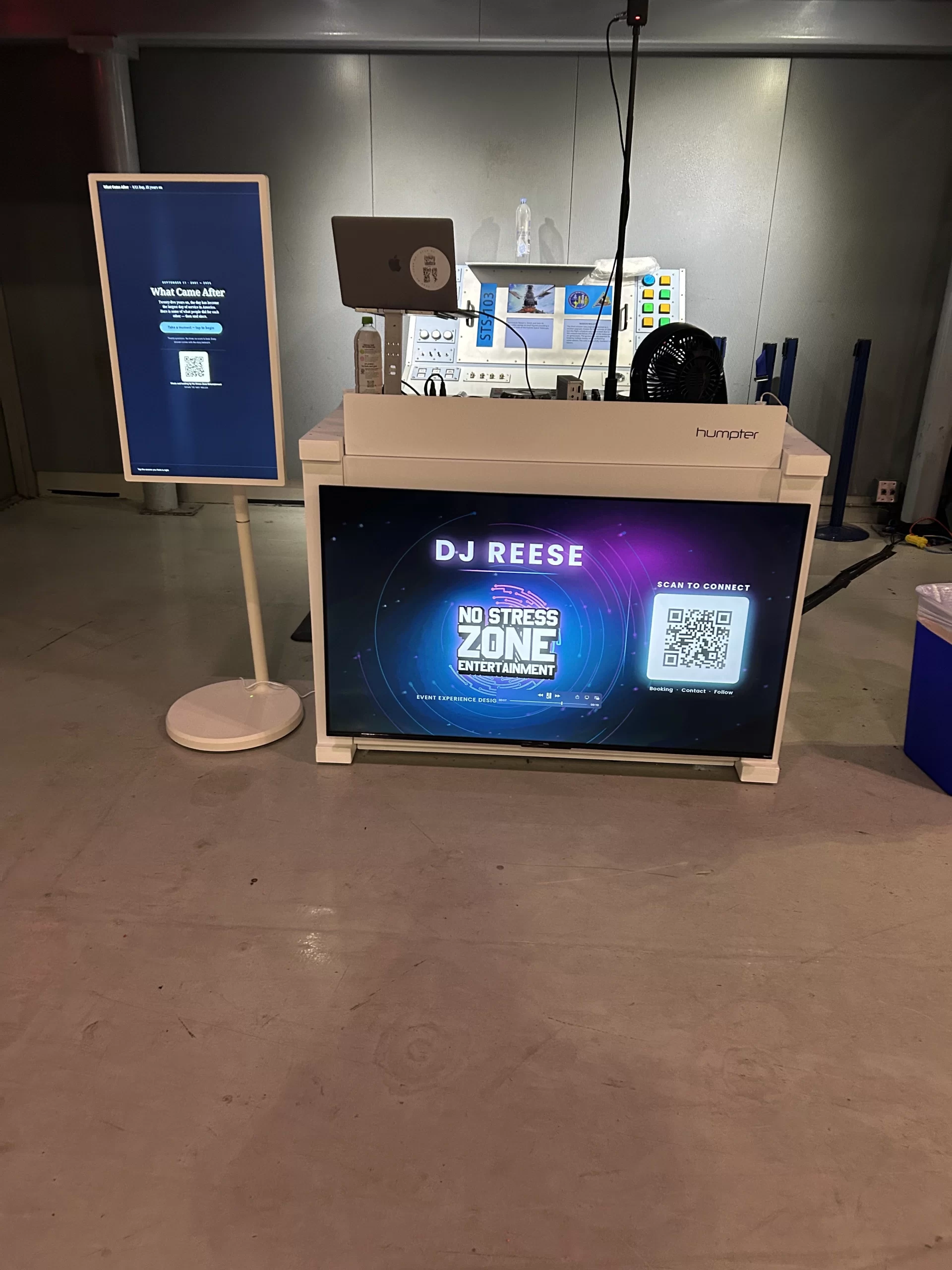
What it actually is
- A touchscreen kiosk placed where your audience already is, at registration, in the exhibit hall, beside the bar, at the entrance to the general session.
- A DJ TV booth that puts the same experience on a large screen where the room can see it, so participation becomes visible rather than private.
- A custom application we build for your event, running on both.
- Someone reading the room all night who can change what is on the screen when the energy calls for it, because the person running the app is the same person running the room.
Why custom matters more than it sounds
There are platforms that sell event gamification. They work, and what they give you is the same experience your attendees had at three other conferences this year, with your logo on it.
Because we build ours, the mechanic can be shaped around what your event is actually trying to achieve. A sales kickoff that needs the regions competing is a different build from a conference that needs strangers introducing themselves, which is different again from a brand activation where the objective is dwell time at a booth.
The question we start with is not what game do you want. It is what do you need people to do, and what should be true when they leave.
The problems it solves
The room before the room starts
Every corporate event has a stretch where people are arriving, standing, holding a drink and looking at their phones because there is nothing else to do. That stretch is 30 to 45 minutes and it is completely unprogrammed at most events. A kiosk gives early arrivals something to do that is not their inbox, and it gives them a reason to talk to the person next to them.
Strangers who will not approach each other
Networking fails because adults will not introduce themselves without a pretext. A shared screen with something on it is a pretext. This is the single most reliable use of the kiosk and the one planners underestimate.
Dwell time at a booth or activation
At brand activations the measure is how long people stay and whether they engage. Something interactive holds people in a space far longer than signage and a giveaway, and it produces a reason for them to be there beyond taking the free item.
The gap nobody owns
Scoring delays at awards nights, room resets, a speaker who has not arrived, a demo being fixed. A screen with something happening on it turns dead air into a moment the room does not experience as a failure.
Where it debuted, and what it actually was
We built it for the 25th anniversary of 9/11 Day and ran it as the debut test of the system, at the meal pack at the Intrepid in 2026, across four days from September 8 to 11, the 25th anniversary of the attacks. Thousands of volunteers moved through in shifts, and every shift beat its goal count.
The build was a 25th anniversary trivia app. It asked volunteers what they knew about 9/11 Day, and under every answer it put a written explanation and the story behind it. That second part is the part that mattered. A trivia app that only tells you whether you were right is a distraction. One that answers the question properly turns a few idle minutes into something a person leaves knowing, which on that floor, on that anniversary, was the entire point.
People played it. Not a handful, and not only volunteers filling time. The national program director played it.
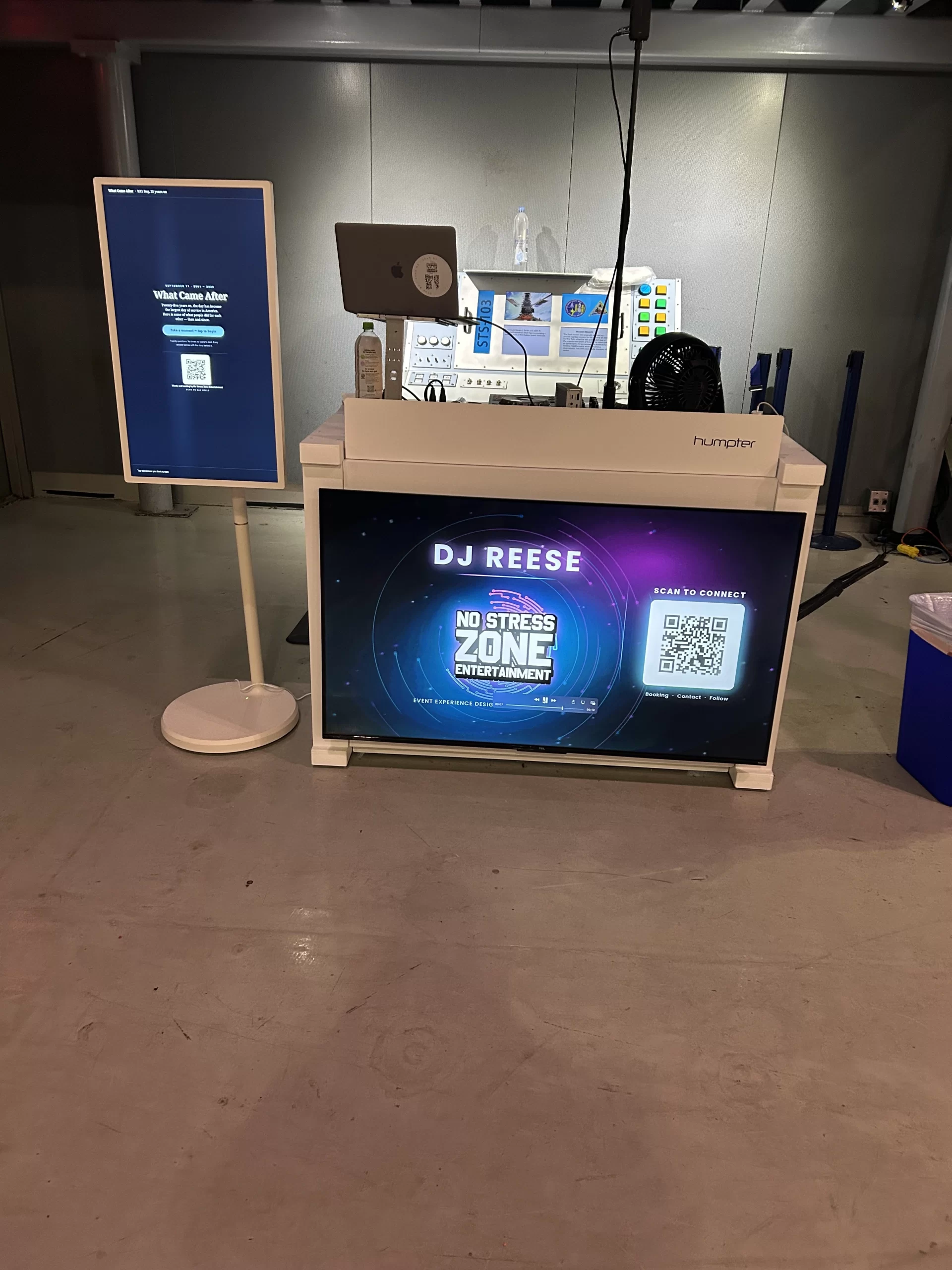
That was the right room to prove it in, because a volunteer packing floor is the hardest version of the problem. The audience changes completely every few hours, nobody has time to learn anything complicated, and the only thing that matters is whether the room moves. If it works there it works in a ballroom.
The booth itself carries a second screen facing the room, running our branding and a QR code so anyone can connect to what is happening from their own phone. The kiosk and the booth are two access points to the same thing: one for the person standing in front of it, one for everyone else.
What a planner actually gets
- A scoping call where we work out what the app has to do, based on your event objective rather than on a feature list.
- A build, made for your event, delivered and tested before the day.
- The hardware, brought and set up by us, with no additional AV line item and no rental to arrange.
- Operation on the day by the same person running your music and your run of show, so the screen and the room are being read by one person.
- Whatever the app captured afterwards, in whatever form is useful to you.
Which events it fits
- Conferences and summits, where the target is attendees meeting each other rather than only attending sessions.
- Sales kickoffs, where competition between teams or regions is already part of the culture.
- Brand activations and experiential marketing, where dwell time and participation are the measure.
- Conventions and trade shows, where a booth or hall needs a reason for people to stop.
- Employee appreciation and holiday events, where the goal is participation rather than a program.
Where it does not fit, and we will say so: board dinners, investor days, executive recognition dinners and anything where the room wants conversation rather than activity. Putting a screen in those rooms works against them.
How this connects to everything else we do
This is not a separate product bolted onto a DJ booking. Audience engagement is the job, and the kiosk is one more instrument for doing it, alongside the music, the microphone and the run of show. The advantage of one person holding all of them is that when the room dips, the response can come from any of them, chosen in the moment.
Questions we get
Do we need to provide screens or wifi
We bring the kiosk and the TV booth. Wifi is preferred and we will tell you at scoping whether your build depends on it, because some do not need it at all, which matters in convention centers.
How long does the build take
Scope it at the same time you book us. Most corporate events book us 60 to 90 days out and that is a comfortable runway. Shorter is possible with a simpler build.
What does it cost
It is quoted on inquiry and priced separately from the performance, because it is development work and there is no standard version of it. The number depends on what the app has to do, whether it has to work without wifi, how much content has to be written, and whether it runs for one night or a multi stop tour.
Tell us the objective and you will get a written number. There is no equipment rental for you to arrange, because the kiosk and the booth are ours.
Can we brand it
Yes. It is our build, so your identity goes in it properly rather than being dropped into a template.
Next step
Tell us what you need your audience to do and what should be true when they leave. We will come back with what we would build and what it would take.