Corporate corporate service day host is a different assignment than a corporate DJ, a wedding host, or a keynote MC. A corporate corporate service day host builds the energy that turns a warehouse full of packing tables into an enterprise volunteer moment employees actually remember. The room is not there for entertainment. The room is there to serve, to pack meals, build bikes, assemble hygiene kits, or complete some other production line task that translates a corporate CSR commitment into a measurable outcome. The person on the mic has to hold two tones at once: the gravity of the day, and the momentum needed to hit an ambitious production goal within a fixed window.
This post is a working breakdown of what the corporate service day host role actually does, why the corporate service day host role is different from every other mic assignment, and what corporate CSR teams and program leads should look for when evaluating a corporate service day host for their next national service program. It draws on seven consecutive years of hosting the NYC flagship 9/11 Day Meal Pack at the Intrepid Sea, Air & Space Museum, the largest single day charitable service event in the United States.
On This Page
Why the corporate service day host Role Is Not Entertainment

The mistake most corporate CSR teams make when booking a the corporate corporate service day host for a service day is treating the assignment like a corporate party. They book a wedding DJ, a keynote MC, or a general purpose entertainer. Then on the morning of the event, that entertainer walks in and realizes the room is filled with 9/11 families, first responders, veterans, and thousands of employees who took the day off work to pack meals. The room does not want to be entertained. The room wants to be led through a production line with respect and momentum.
The corporate corporate service day host has to walk in understanding that reality from minute zero. The tone of the day is set within the first 60 seconds of the opening address. Miss that tone and the entire day feels off. Hit it and the room settles into the rhythm and the packing goal becomes achievable.
According to Points of Light, September 11 is now the largest single day of charitable service in the United States, with millions of hours of volunteer service performed annually across meal packs, blood drives, hygiene kit assembly, and community service events. That scale means the tone of the day matters at the national level, not just at the individual event.
Holding Two Tones on the Same Floor

The technical challenge of the corporate service day host role is holding two tones simultaneously. Tone one is remembrance, solemn, respectful, aware that many people in the room have direct personal connection to what the day marks. Tone two is momentum, energetic, focused, driving a packing line toward a 20 million meal goal in a fixed window. Both tones have to be present in the same room, sometimes in the same 10 minute stretch.
The transitions between the two tones are where a corporate service day host earns the assignment. The moment of silence has to end without abrupt shift into celebration. The energy climb has to build without ever crossing into party. The tone of remembrance has to be maintained even during the peak packing rush when 3,000 volunteers are hitting their stride. A vendor who cannot manage the transition rhythm will produce a day that feels emotionally off from the first hour.
- Opening remarks, moment of silence, 9/11 family or first responder representative, national anthem
- Transition to packing, respect maintained while energy climbs into production rhythm
- Peak packing window, team captains hyped by name, packing count updates, sustained focused energy
- Sponsor and stakeholder moments, cued into the packing rhythm without breaking the flow
- Wind down, final meal count, closing remarks, thank you to organizers and volunteers
The Packing Line Rhythm

Meal packs are production lines. Volunteers stand in stations of six to eight, and each volunteer has a specific corporate service day host role, measuring rice, sealing bags, boxing sealed bags, stacking boxes. The line only hits its packing goal if the rhythm is sustained. Music tempo, mic pacing, and count updates from the mic all feed the rhythm directly.
Music selection during the packing hours is a specific curation. Tempo has to be moderate enough to sustain hours of physical work without burning out volunteers. Genre has to feel appropriate to the day, no party tracks, no aggressive drops, no lyrics that clash with the tone. Volume has to be loud enough to carry across a large open packing floor without drowning out mic cues. Every one of those decisions has to be right for the day to flow.
Meal count updates as motivation
The meal count on the big screen is the single strongest motivator during a service day. The the corporate corporate service day host reads the count off the screen at strategic intervals, usually every 15 to 20 minutes, and connects the number back to the ambition of the day. “We just crossed 100,000 meals in this room. Nationally we are at 4 million. Keep it moving.” That connection is what turns a physical packing task into a mission volunteers can feel proud of.
Handling Stakeholders and Speakers
A national service day pulls in speakers from multiple stakeholder groups, 9/11 family members, first responders, elected officials, celebrity guests, corporate sponsor executives, community organization leaders. Each has a specific moment on the run of show. The corporate corporate service day host is responsible for introducing every speaker cleanly, cueing applause at the right beats, handing off the mic without stepping on the moment, and returning the room to the packing rhythm after each speaker exits.
Names have to be pronounced correctly. Titles have to be current. Speaking order has to match the printed program. Handoffs have to be smooth. Any one of those beats missed and the corporate team is fielding awkward feedback from their most important stakeholders after the event. Hit them all and the stakeholders leave impressed with how the day was run.
The Intrepid as a Service Day Venue
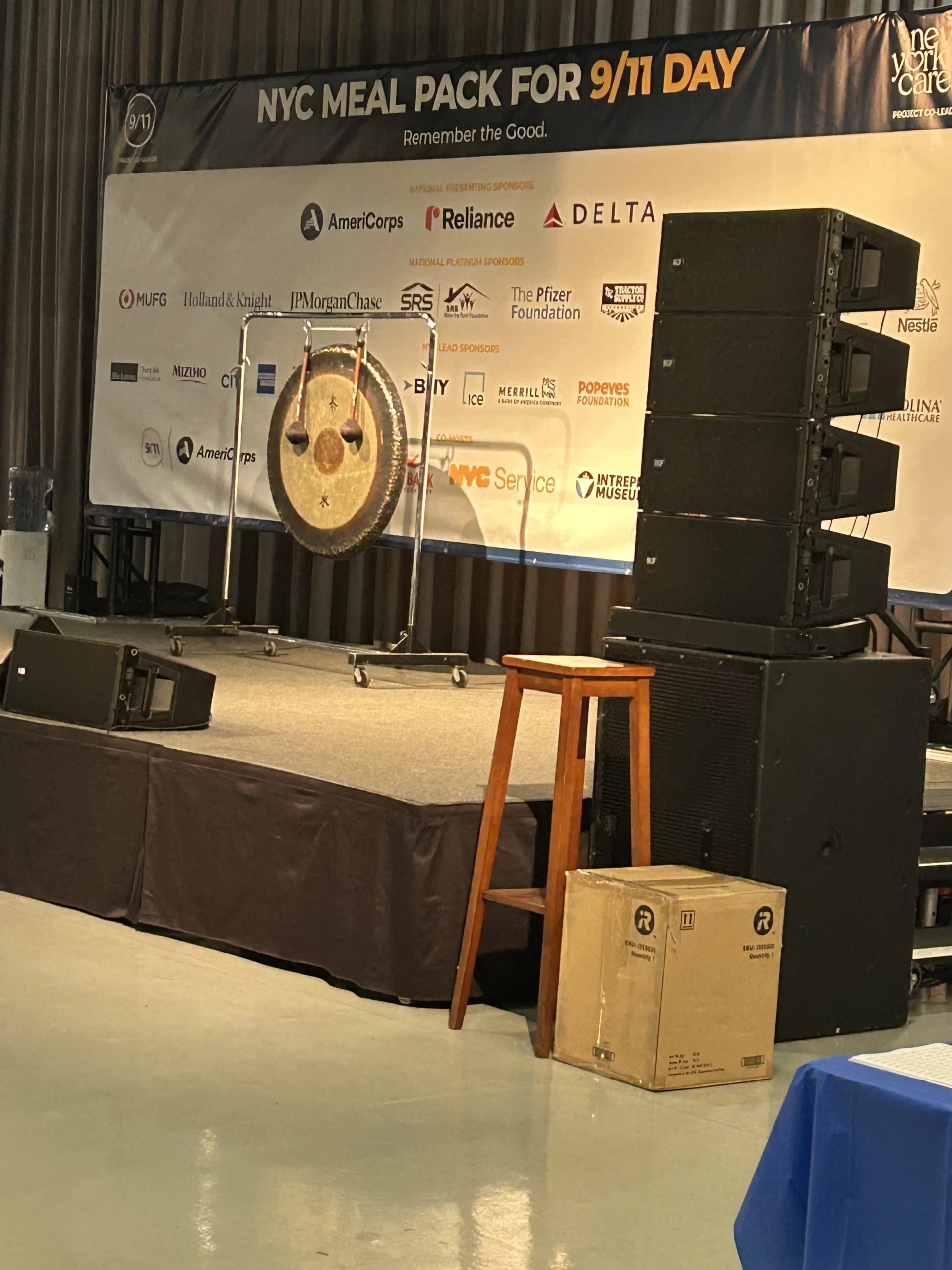
The 9/11 Day Meal Pack NYC flagship happens on the flight deck of the Intrepid Sea, Air & Space Museum, a 900 foot aircraft carrier that served in World War II and Vietnam. The venue is not neutral. It carries the weight of the day in its physical presence. Hosting on that deck means the tone is set by the space before the mic ever comes on. a corporate service day host who does not respect that setting reads immediately as out of place.
The Intrepid also creates specific technical challenges. The deck is large and open, which means sound reinforcement has to be planned carefully. Weather can shift the day in real time. Access and load in for equipment are constrained by the ship’s physical layout. Working these constraints requires either extensive prior experience on the deck or a very good production team briefing.
Booking Your corporate service day host
If you are on a corporate CSR team and evaluating vendors for a service day, the questions to ask are specific. Has this vendor hosted a service day before, or are they treating it like a corporate event? Can they hold remembrance tone and packing momentum in the same room? Do they know how to run a production line off the mic? Do they have references from national program organizations, not just corporate clients?
Those questions filter fast. Most vendors who bid on service day work have never actually run one. The ones who have will describe the specific mechanics, the moment of silence, the transition, the meal count, the stakeholder handoffs, with confidence and specificity.
Why 9/11 Day Rebooks the Same Host
Seven consecutive years is the strongest signal a national program of that scale can send. The full 9/11 Day Meal Pack case study covers the program in detail, the 20 million meal national goal, the 50 plus city scope, the Intrepid flagship, the community first framing. The rebooking pattern reflects that the corporate corporate service day host role at that scale requires operator level experience, the same reason CBRE, LIDL US, and other Fortune 500 enterprise clients in the complete corporate DJ case studies portfolio keep the same operator on the mic year after year.
Corporate Service Day Programs Beyond 9/11 Day
Other corporate service day programs run on similar mechanics. Enterprise companies increasingly run internal service days built around Habitat for Humanity builds, food bank sorts, hygiene kit assembly for local shelters, and school supply drives. The corporate service day host role of the corporate corporate service day host on those programs is identical to the 9/11 Day model, hold the tone, drive the momentum, cue the speakers, manage the production rhythm. a corporate service day host with 9/11 Day experience is directly transferable to those internal corporate service days.
National Service Day Programs Beyond September 11
Enterprise CSR teams increasingly run service programming across the calendar, Martin Luther King Jr Day of Service in January, Volunteer Week in April, September 11 in the fall, Giving Tuesday in November. Each has its own tonal considerations. MLK Day carries civil rights history that has to be honored. Giving Tuesday runs shorter and lighter. All of them share the same operational requirement, a corporate service day host who can hold gravity and momentum on the same floor.
Corporate volunteer engagement metrics
The measurable outcomes CSR teams should track on service days are volunteer attendance rate, packing or production goal completion percentage, stakeholder speaker feedback, employee post event survey NPS, and social media coverage across the corporate channels. Companies that run their service days well see participation growth year over year, a signal that employees found the experience worth their day.
Working with the national program organizers
National programs like 9/11 Day, Habitat for Humanity, and Points of Light have specific expectations for how their events are produced. The host is often the direct interface between the corporate sponsor team and the national program organizers on the day. Managing that relationship well ensures rebooking for the following year and a professional referral into other program events.
What Makes the Intrepid Different From Other Service Day Venues
Most corporate service days happen in generic event spaces, hotel ballrooms, warehouse floors, convention centers. The Intrepid flight deck is not that. The venue itself carries the emotional weight the program is honoring. Volunteers arrive already in the right mindset. The host job is to sustain that mindset, not create it. That is easier than starting from a neutral space and building the tone through the mic alone.
For CSR teams evaluating venue options for future service days, the venue emotional register should be a top consideration. A venue that adds emotional weight, a national memorial, a historically significant site, a location tied to the cause, reduces the operational lift on the corporate corporate service day host and improves the participant experience.
corporate service day host and Employee Volunteer Experience Design
The employee volunteer experience on a service day is the third layer of consideration after the honoring of the day itself and the completion of the production goal. Employees who show up expect to leave feeling like their time mattered. That feeling is a design outcome, it does not happen by accident. The mic pacing, the packing rhythm, the recognition of team captains by name, the count celebration moments, the closing thank you all contribute to whether employees walk away wanting to come back next year.
Repeat volunteers are the compounding value of a well run service program. A CSR team that produces a strong first year experience sees larger participation the second year, and larger still the third. Companies that produce weak first year experiences see participation flatline or decline as employees decide the day was not worth taking off work. The mic is where that experience gets set.
Team captain hype as engagement lever
Most service days organize volunteers into teams of six to eight at a packing station, with one team captain who manages the station’s rhythm. Hyping team captains by name from the mic during peak packing is one of the highest ROI engagement moves available. The captain feels seen, the team rallies around them, the station’s output climbs, and the memory of being recognized by name stays with the volunteer long after the event.
Media and PR Coverage on Service Day
Service days regularly attract local and national press. NBC, CBS, and Fox local affiliates typically cover the NYC flagship 9/11 Day event, and corporate CSR teams get significant sponsor mention if the event is produced professionally. Coordinating with the press team on the day, timing interviews around packing peaks, giving reporters access to the count moments, ensuring stakeholder speakers are available for quotes, is another job that falls to the mic and the production team.
Press coverage compounds the value of a service day beyond the direct participation numbers. A well covered service day extends the corporate CSR story into the company’s earned media plan for the year. That coverage in turn helps recruit larger stakeholder participation the following year.
Working With Corporate Marketing Teams on the Vendor Selection Process
Vendor selection for enterprise events runs through procurement, not through friend of-a-friend referrals. Corporate marketing directors typically issue an RFP to three to five qualified vendors, review capabilities documents and past client references, run reference calls with the two or three finalists, and negotiate final scope and pricing with the winner. That process compresses to about six to eight weeks from RFP issuance to signed contract for most enterprise activations.
What separates vendors that make the shortlist from those that get filtered out is usually the specificity of the capabilities response. Generic language about “bringing energy” and “creating unforgettable experiences” reads as boilerplate. Specific descriptions of prior work with named clients, defined outcomes, and operational mechanics reads as professional. Marketing directors reviewing capabilities documents can spot the difference in the first two pages.
Reference calls that separate vendors
The reference call is where marketing directors validate whether the vendor delivered what they promised. Good reference conversations cover the actual on the day performance, communication before and after the event, how the vendor handled unexpected moments, and whether the reference client would rebook. Marketing directors who ask specific behavioral questions get useful information. Directors who ask generic praise fishing questions get useless information.
The Contract and Scope Documentation That Protects Both Sides
Clear scope documentation prevents the majority of client vendor conflicts. A well written enterprise event contract covers arrival time, load in expectations, setup responsibilities, the specific hours of active performance, break windows, tear down responsibilities, backup and contingency plans for equipment failure, pre event brief timing, and post event debrief expectations. Contracts that leave these ambiguous produce disputes that damage the relationship.
The best enterprise vendors bring standard scope documents to the contract conversation rather than waiting for the client to draft them. That signals professionalism and reduces the marketing team’s operational lift. Vendors who ask the client to draft the scope typically produce lower quality events because the scope reflects the client’s guess at what should be included rather than the vendor’s operational reality.
Proof from the room: see how we hosted 45 Johnson & Johnson volunteers through a first aid kit build.
Frequently Asked Questions
What makes corporate corporate service day host different from generic event work?
Working corporate corporate service day host for an enterprise client is fundamentally different from generic event or entertainment work. The stakeholder complexity, brand risk, run of show discipline, and rebooking dynamics all operate at a different level than one off consumer events. Vendors who understand these differences produce measurably better outcomes across enterprise client relationships.
How is success measured for corporate corporate service day host?
Success measurement for corporate corporate service day host at enterprise scale focuses on measurable business outcomes rather than vibes. Rebooking rate, stakeholder feedback, on the day execution quality, and follow through metrics all factor into whether the client considers the engagement successful enough to continue the relationship.
Why does corporate corporate service day host require specialized vendor experience?
Specialized experience matters for corporate corporate service day host because the operational patterns, stakeholder handling protocols, and brand voice requirements do not transfer from generic entertainment vendor work. Vendors who have accumulated years of enterprise specific reps deliver measurably stronger outcomes than vendors bringing consumer event backgrounds to the same assignments.
Key Takeaways for Enterprise Marketing Teams
- Understand the operational patterns, corporate corporate service day host at enterprise scale runs on defined mechanics, not on entertainment instincts.
- Prioritize rebooking over price, long term corporate corporate service day host vendor relationships compound value across every subsequent engagement.
- Vet for enterprise experience specifically, vendors who have worked corporate corporate service day host for enterprise clients bring transferable knowledge that consumer event vendors cannot replicate.
- Measure outcomes beyond the day, stakeholder feedback, rebooking signals, and post event follow through are stronger success metrics than attendee counts.
- Document what worked, structured debriefs after every engagement produce compounding learning that improves the program year over year.
For additional context on corporate corporate service day host best practices, see Event Marketer’s enterprise activation coverage, the industry’s leading publication tracking enterprise brand experience programming across categories and regions.