A venue sound system is built to cover a room. A corporate event DJ is hired to shape it. Those are different problems, and the house system solves only the first one.
“What a joy it was to have DJ, so much so we hired him for our next 2 festival shows! Did such a great job working the crowd. Highly recommended him!”
, Christina C., verified client review
Real Proof: DJ Reese On Site
This 300 guest life sciences conference in Newark, NJ is what a booked corporate DJ actually brings versus a venue’s house sound system: DJ Reese’s own audio rig, tuned and run by the person operating the room, not a fixed system built for background music.
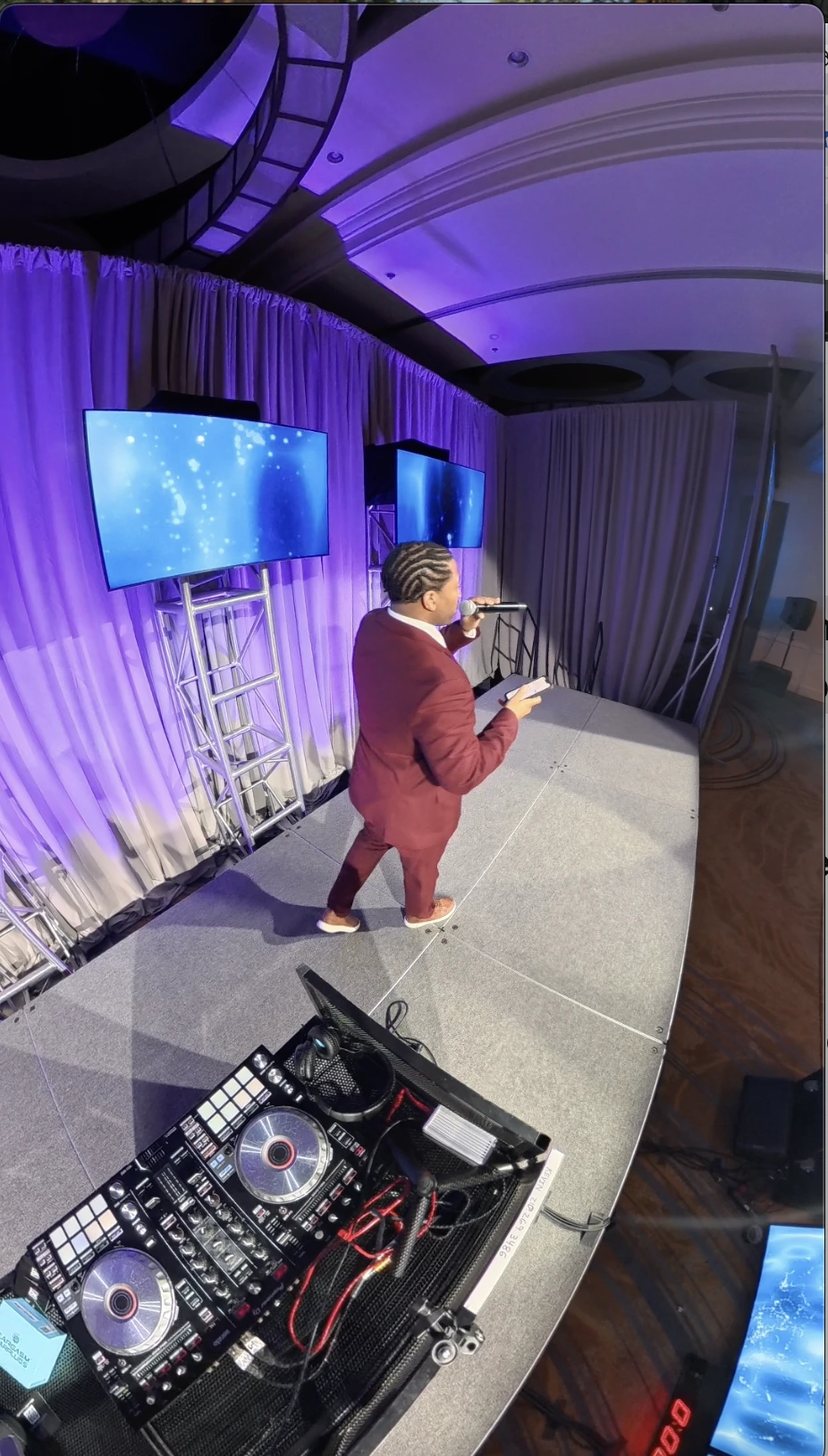

Rated 5.0 from 121 Google reviews. Read the full Newark life sciences conference write up →
A venue sound system is built to cover a room. A corporate event DJ is hired to shape it. Those are different problems, and the house system solves only the first one.
Venues are not overselling when they say the system is good. Most ballroom systems are genuinely fine for speech and background music. The question is what happens when your program needs more than coverage.
What house systems do well
- Speech reinforcement for a podium or a lavalier microphone
- Even background music in a standard ballroom
- Simple playback from a laptop for a slideshow or a video
- Zone control between a foyer and a main room, in better venues
Where they run out
Ceiling speakers are aimed at seats, not at a moment
Distributed ceiling systems spread sound evenly and flatly. That is ideal for announcements and wrong for a reveal, an award or a walk up, where you want the room to feel a lift rather than hear a louder version of the same thing.
Control usually sits in a locked rack
If the only volume control is behind a wall panel or with a house tech who is covering three rooms, nobody is adjusting during dinner service. The level you set at 6pm is the level you have at 9pm, and the room has changed completely by then.
Outdoors, the house system is not part of the conversation
Across 74 Lidl US grand openings, most of the program happens in a parking lot or on a sidewalk. Wind moves sound, there is nothing to reflect off, and a crowd builds outside the store. We bring the system because the venue does not have one that reaches there. In Northeast Philadelphia on December 2, 2020 that meant running an outdoor opening in winter, under pandemic rules, with hundreds of people waiting.
Nobody at the venue owns your program
This is the real gap. The house system has no opinion about whether the room is fading after lunch. A person does.
How to tell before you sign
- Ask where the volume control lives and who touches it during your event.
- Ask whether the system is zoned, and whether the foyer and the main room can differ.
- Ask what happens if a wireless microphone fails mid session, and who has a spare in the room.
- Ask whether the ceiling system can be bypassed for a front of room setup during awards.
- Walk the far corners of the room during the site visit and listen there, not at the front.
What we bring, and when
For a seated conference in a good ballroom we often run through the house system and bring our own mixer and a backup microphone. That backup is not theoretical. At the Alliance for Science East Coast Conference at the Marriott Newark Airport on April 29, 2026, the AV team’s wireless microphone failed mid session and ours was in the speaker’s hand within about 8 seconds.
For activations, outdoor events, receptions with a dance element or anything where the room needs to move, we bring our own front of house system and place it for the crowd rather than for the architecture.
Cost, honestly
Using the house system can save money, and sometimes we recommend it. A single day corporate program typically runs $5,000 to $8,000, and gear scope is one of the variables. We will tell you when your venue is enough, because turning up with more than the room needs is its own kind of failure. See the pricing calculator.
Proof from the room: see every industry we have worked in, with proof.
Frequently asked questions
Can you plug into the venue system?
Usually yes, with a line check before doors. Our technical rider is in the media kit.
Who decides, us or the venue?
Your producer decides. We give an honest read after seeing the room and the agenda, and we coordinate with the venue AV team either way. See DJ vs in house AV.
What about hybrid events with a stream?
That changes the answer. The stream needs a clean feed, which means the house or production system carries more of the load and we coordinate the split in advance.
Next step
Send your venue name and floor plan and we will tell you whether the house system is enough. Check your date.
Frequently Asked Questions
What should you plan for first with this type of event?
Ceiling speakers are aimed at seats, not at a moment Distributed ceiling systems spread sound evenly and flatly. That is ideal for announcements and wrong for a reveal, an award or a walk up, where you want the room to feel a lift rather than hear a louder version of the same thing.
What’s the most common mistake to avoid?
Ask where the volume control lives and who touches it during your event. Ask whether the system is zoned, and whether the foyer and the main room can differ.
What actually matters most on the day?
For a seated conference in a good ballroom we often run through the house system and bring our own mixer and a backup microphone. That backup is not theoretical.