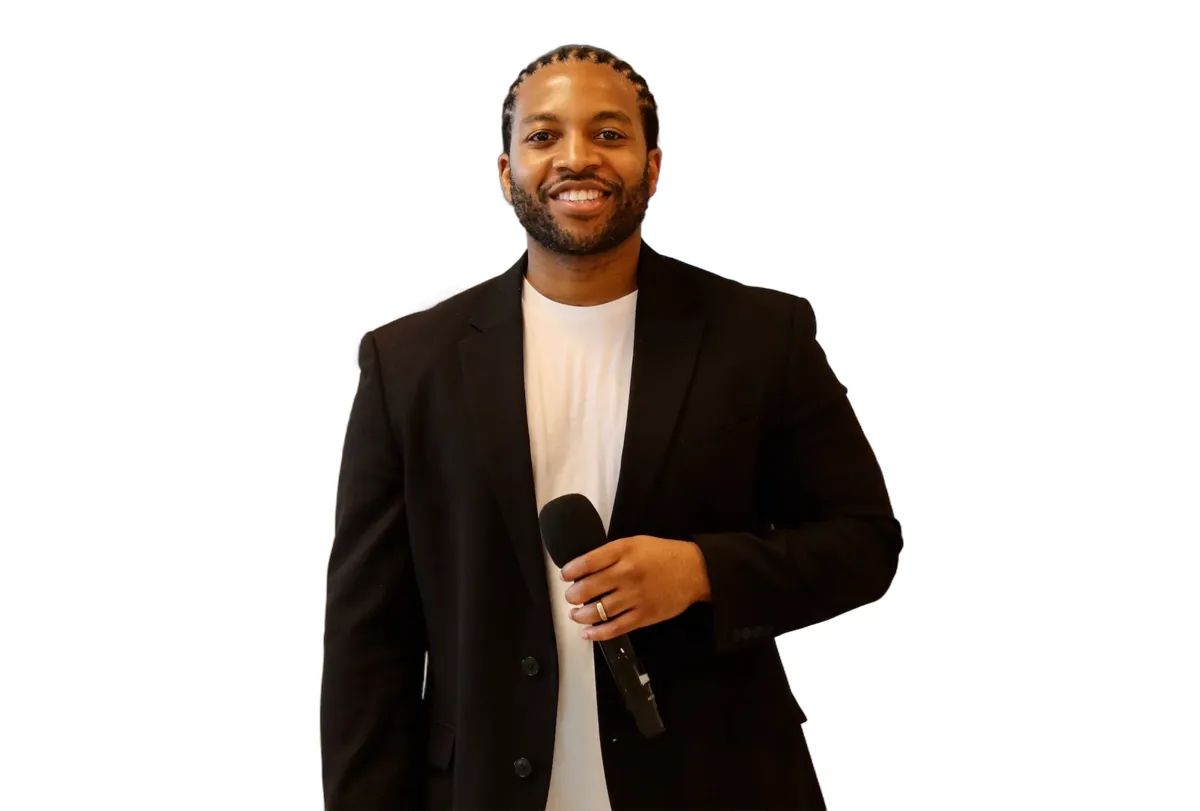
An event MC runs the program on the microphone: welcomes, introductions, transitions and keeping the schedule. A DJ runs the music: walk-in, background and dance sets. Most corporate events with a program need both jobs covered.
Event MC vs DJ is the debate every corporate event planner walks into and nobody explains clearly. So planners default to booking both or hiring a hybrid without understanding what either role actually does in the room.
Looking for a host for your program? See our corporate event emcee services, with case studies from New York, New Jersey, Philadelphia and Washington DC.
Here is the real event MC vs DJ breakdown. What each role does. Where they overlap. When you need one, the other, or both. And how to structure the booking so the room feels tight instead of choppy.
Table of Contents
- The MC Role Defined
- The DJ Role Defined
- Where Event MC vs DJ Roles Overlap
- When You Need an MC
- When You Need a DJ
- When You Need Both
Where we have run the mic, the music or both
We work corporate events as MC, as DJ and most often as both from one position. These are the rooms behind the advice below:
- FTF News Awards, Hard Rock Hotel New York, 2025 and 2026. We opened the show, welcomed the room, introduced the founder and ran walk up music for every winner from the same position. Case study
- RMS Sales Kickoff, Martin’s Crosswinds, Greenbelt, Maryland, March 22, 2026. 500 attendees, more than 20 segments, zero dead air, booked two years in a row. Case study
- Lidl US Strategy Conference, Renaissance Arlington, 2025. More than 500 attendees, emcee and DJ. How we ran it
- 9/11 Day at the Intrepid, New York. We were the DJ from 2020 through 2025. In 2026 the role expanded to hosting, with announcements, introductions and parts of the run of show. Case study
- Brand activations and association conferences for PUMA, adidas and Ashley Furniture, and conference work for the Diversity Alliance for Science.
The MC Role Defined

The MC owns the spoken word in the room. Introductions. Transitions. Announcements. Storytelling between programming beats. Every event MC vs DJ conversation should start with clarity on what the MC actually does.
A skilled MC bridges gaps in programming without making the audience aware there is a gap. When a keynote runs long or a speaker cancels, the MC absorbs the disruption and keeps the room moving.
The MC also carries the emotional tone of the event. That is the piece most planners underestimate in the event MC vs DJ discussion. Tone control is not automatic. It requires an MC who has studied your organization, your audience, and your programming intent.
Great MCs also handle audience management. Getting a distracted room to focus. Coaxing a shy crowd to engage. Cooling a rowdy room without killing the energy. These are the invisible skills that separate a real MC from a talking head.
The DJ Role Defined
The DJ owns the sonic layer of the room. Music selection. Timing. Volume dynamics. Sound design for transitions. The event MC vs DJ conversation clarifies that these responsibilities are technical, not entertainment.
A skilled DJ reads the room in real time and adjusts. Volume up when energy needs building. Volume down when the MC is about to speak. Genre shift when the room shifts. Every choice serves the event, not the DJ’s ego.
The DJ also carries technical execution responsibility. Sound system setup. Backup gear management. Mixer coordination with venue audio. Cable runs and power distribution. Every technical failure in the audio layer traces back to the DJ.
Elite DJs also manage the mic. When the MC speaks, the DJ is monitoring levels, cutting feedback, and making sure every word lands cleanly in the room and on the recording. That is not a music job. That is a technical execution job that sits inside the event MC vs DJ conversation.
Where Event MC vs DJ Roles Overlap

The event MC vs DJ conversation gets confused because there is real overlap. Both roles read the room. Both roles adjust in real time. Both roles serve the programming and the audience.
The most important overlap is transitions. When the MC hands off to a keynote speaker, the DJ underscores the moment. When the DJ builds energy for a program pivot, the MC lands the transition with words. That handoff is choreographed, not improvised.
Both roles also share responsibility for pacing. If the MC talks too long, the DJ starts a subtle build to signal the room to move on. If the DJ plays too much between segments, the MC brings the room back with a spoken cue.
Where event MC vs DJ overlap ends is decision authority. The MC has final call on program flow. The DJ has final call on sonic execution. When they conflict on a call, the event producer usually breaks the tie based on run of show priority.
When You Need an MC
You need an MC when the event has significant spoken content that requires connective tissue. Multiple speakers. Multiple award moments. Multi program transitions. Any event with more than three programd beats needs an MC.
Award shows are the clearest event MC vs DJ decision. An award show without an MC feels like a sequence of unrelated presentations. An award show with an MC feels like a coherent narrative arc. That gap shows up fastest in a room full of honorees waiting to hear their name. If you are staffing a recognition program specifically, our corporate award show host guide breaks down the traits that separate a host who elevates the moment from one who just reads names off a card.
Conferences with keynote programming also need an MC. Even when speakers are strong, someone needs to introduce them, thank them, and land the audience back into the next segment. That is MC work, not DJ work.
Panel discussions especially need MCs. Moderating a panel is spoken word coordination at scale. A skilled MC keeps the panel on time, on topic, and engaging without dominating the panelists.
When You Need a DJ
You need a DJ when the event has significant energy management requirements. Dance floors. Cocktail hours. Networking receptions. Any event where the sonic layer defines the attendee experience.
Company parties are the clearest event MC vs DJ decision on the DJ side. A holiday party without a DJ feels like a work function. A holiday party with a DJ feels like an event people want to attend.
Product launches also need DJs. The pre event, during event, and after event energy all require sonic coordination. Music curation, transition management, and volume dynamics all live inside the DJ scope.
Cocktail hours before formal programming are DJ territory. The music sets the tone for the entire event. Get it wrong and the room struggles to warm up to the main program.
When You Need Both an Event MC and DJ
Most corporate events need both. Sales kickoffs. Conferences. Annual galas. Product launches. Any event with structured programming and open reception time.
The event MC vs DJ decision to book both should also come with a coordination protocol. The two need to meet before the event. They need to walk cues together. They need to align on hand off signals.
Booking both without coordination creates two independent operators competing for room attention. That is worse than either alone. It is choppy. It is disjointed. And the audience feels it.
Some vendors offer hybrid packages where the DJ and MC are the same person or come from the same team. Event MC vs DJ hybrid packages work when the coordination is already built in and the vendor understands both disciplines. Galas are where this hybrid model earns its keep. A single coordinated team can carry the room from cocktail hour through the recognition segment and into open dancing without a handoff gap, which is why our gala and awards services are built around exactly that combined MC and DJ structure rather than treating the two as separate bookings.
Pricing Differences in Event MC vs DJ Bookings
The event MC vs DJ pricing conversation confuses buyers. MC fees and DJ fees are structured differently because the work is structured differently.
MC fees are typically hourly or per event with heavy pre production time built in. A skilled MC spends 8 to 12 hours preparing for a 3 hour event. That prep is what makes the event feel effortless.
DJ fees typically include gear rental, setup time, and performance time. The pre production prep is smaller in hours but heavier in playlist curation and technical planning.
When you book both, expect a 30 to 50 percent premium over booking just one. That premium reflects the coordination overhead and the dual scope. Bundled event MC vs DJ pricing from a single vendor is often 15 to 20 percent lower than sourcing separately.
In dollar terms, single day combined DJ and MC coverage from our team generally runs $5,000 to $8,000 depending on event length, scope and equipment, with multi day and multi city events scoped separately. You can build a custom estimate with our pricing calculator.
Common Mistakes in Event MC vs DJ Booking
The most common mistake in event MC vs DJ decisions is booking only a DJ for an event that needs an MC. The DJ tries to fill the MC role with awkward mic breaks and the room feels chaotic.
The second mistake is booking only an MC for an event that needs a DJ. The MC talks to fill space that music should own. The room feels heavy instead of light.
The third mistake is booking a wedding DJ and expecting corporate MC skills. Wedding DJs often have great DJ chops and mediocre MC skills. The event MC vs DJ vetting has to separate these two competencies.
The fourth mistake is skipping the pre event coordination call between the MC and DJ. Even hybrid vendors need this call. Every event is different and every run of show has its own cue map.
The fifth mistake is treating the MC as an afterthought. The MC is your voice to the room. Booking cheap or booking late leaves you with an MC who cannot deliver.
How to Choose Between Event MC vs DJ Vendors
When choosing between event MC vs DJ vendors, ask three questions. Show me a live event video where you owned the room. Give me two current references. And walk me through your coordination protocol.
The live event video is the fastest filter. If they cannot show you a 60 second clip of them owning a real corporate room, they are not delivering at the tier you need.
Current references validate consistency. One old glowing testimonial does not equal three current clients willing to take your call. The event MC vs DJ vetting is stricter than most planners realize.
The coordination protocol tells you whether the vendor thinks about the event holistically or just about their portion. Vendors without a real coordination protocol will hand off badly on show day.
For related reading, see corporate emcee for hire guide and how to hire a corporate DJ. Also review corporate event DJ cost for scope pricing context.
Event MC vs DJ Rehearsal Protocol
The best event MC vs DJ combinations run a technical rehearsal before doors open. Even 30 minutes is enough to catch coordination gaps that would otherwise embarrass the room during the live show.
The rehearsal should cover mic checks, cue timing, walk on and walk off transitions, and any planned improvisation windows. Nothing beats a live run through for building the muscle memory both operators need.
Skipping the rehearsal is the leading cause of choppy event MC vs DJ execution on show day. Every operator who has been embarrassed by a missed cue eventually starts insisting on rehearsals.
Rehearsals are also where audience management strategy gets aligned. If the MC plans to engage a specific table for a Q and A moment, the DJ needs to know the music pattern that supports it.
Backup and Redundancy in Event MC vs DJ Setups
Redundancy for event MC vs DJ setups means backup gear for the DJ and backup notes for the MC. Both operators should have contingency plans for the equivalent of a mic failure or a laptop crash.
The DJ backup obligation is technical. Backup mixer. Backup laptop. Backup mic. Backup power distribution. Every critical piece of gear should have a spare in the truck or on the stand.
The MC backup is intellectual. Notes stored in three places. Program flow memorized. Contingency scripts for common disruptions. A great MC never reaches for a note they cannot find.
The event MC vs DJ redundancy conversation should be part of the intake call. If the vendor cannot articulate their backup plan, they do not have one. Ask for specifics, not reassurance. A vendor who can name the exact backup gear in the truck or describe how the MC recovers a lost train of thought has actually built the redundancy. A vendor who just says “we’ve never had a problem” has not been tested yet, and your event is not the place to find out.
Live Event Adjustments You Should Expect
Every live event requires real time adjustments. Speakers run long. Speakers no show. Executives call audibles. Weather shifts programming. Every one of these requires event MC vs DJ real time response.
The MC has to bridge disruption verbally without making the room feel the mess. The DJ has to bridge disruption sonically without making the mood dip. Both work together to protect the illusion of a smooth show.
Great event MC vs DJ pairs also know when to lean on each other. When the MC needs a pause to think, the DJ fills. When the DJ needs a moment to transition tracks, the MC covers with a joke or an announcement.
Weak pairs fight each other during live disruption. They compete for room attention instead of coordinating. That competition is visible to the audience and it corrodes the perceived quality of the event.
Event MC vs DJ Contract Language Comparison
MC contracts and DJ contracts have overlapping but distinct language. Both need cancellation ladders and force majeure. But the specifics differ based on the deliverable.
DJ contracts must include gear obligation, backup gear commitment, and technical setup time. MC contracts must include prep time, briefing sessions with your leadership, and any scripted moments the MC will deliver.
When you book both from a single vendor, request a single unified contract with role specific sections. That structure prevents blame shifting between operators when something goes sideways on show day.
Event MC vs DJ contract comparison also matters for payment structure. MC contracts often bill on a flat fee. DJ contracts often bill with gear line items. Reconciling these on a single event budget requires clarity from the start.
Event MC vs DJ Skill Overlap Reality Check
The best operators can do both. Not all of them. Some. Those hybrid professionals are worth the premium fee because they eliminate the coordination overhead entirely.
Event MC vs DJ hybrid execution requires the operator to have real reps in both disciplines. Not a DJ who occasionally talks. Not an MC who occasionally plays music. A professional who has developed both skill sets over years of live event work.
Vet hybrid operators harder than single discipline operators. Ask for video from events where they executed both roles. Ask for references who specifically hired them for hybrid coverage. If they cannot produce either, they are one discipline stretching into the other.
Event MC vs DJ hybrid pricing typically lands between the two individual fees. Slightly more than a solo DJ. Slightly less than booking a separate DJ and MC. The savings come from single vendor coordination overhead.
MC vs DJ: FAQ
An MC runs the program on the microphone, and a DJ runs the music. The answers below cover the questions planners ask most.
What is the difference between an MC and a DJ?
The MC runs the program on the microphone: welcomes, introductions, transitions and keeping the schedule. The DJ runs the music: walk in, walk up, background and dance sets. One controls what people hear from the stage, the other controls the sound of the room.
What does DJ MC mean?
A DJ MC is one person who does both jobs: hosts the program and runs the music. At corporate events that removes the handoff between two vendors, which is where timing usually breaks.
What does an event MC do?
An event MC opens the program, introduces speakers and honorees with names and titles right, covers technical delays, announces schedule changes and keeps every segment on time.
Do I need an MC and a DJ, or just one?
If your event has a program with speakers, awards or segments, you need an MC. If it has music people will notice, you need a DJ. When you need both, one person doing both keeps the cues tight. At the RMS Sales Kickoff we ran more than 20 segments that way with zero dead air.
The Bottom Line on Event MC vs DJ
Event MC vs DJ is not either or for most corporate events. It is both, coordinated tightly, executed by professionals who understand both disciplines and how they connect in the room.
The event MC vs DJ decision comes down to programming complexity, audience management needs, and energy management requirements. Match the roles to what your event actually needs.
According to the International Association of Exhibitions and Events, event flow quality is now the top driver of attendee satisfaction scores. That flow requires both MC and DJ execution working together.
Ready to book event MC vs DJ coverage that actually coordinates? Reach out at nostresszoneent.com/contact and I will scope both roles against your event structure. Bring your run of show or even a rough outline of the program, and the scoping conversation moves faster because we are working from your actual event structure instead of guessing at it.