Your AV company and a corporate event DJ are not competing for the same job, and the trouble starts when a planner assumes they are. AV owns the signal path: microphones, speakers, mixers, projection, recording. We own how the room feels and whether the program stays on time.
“We had an incredible DJ at our party! Their energy was infectious, and they kept the dance floor alive all night. The music selection was on point, and they seamlessly transitioned between songs. Our guests couldn’t stop raving about the fantastic atmosphere they created.”
, Madison Childs, verified client review
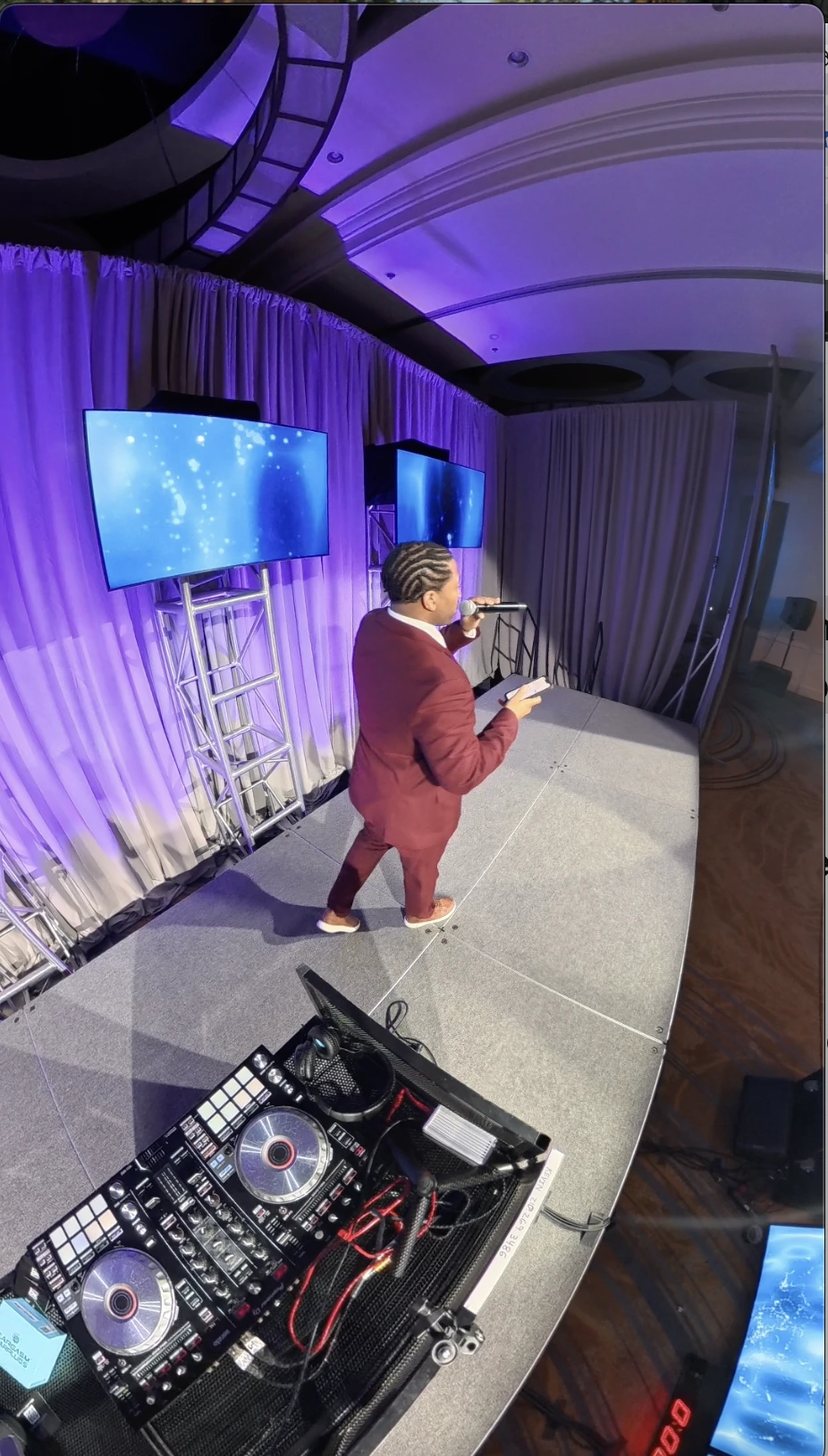
Real Proof: DJ Reese On Site
Real footage from a corporate conference where DJ Reese ran both the audio and the mic as a single accountable operator, the direct comparison point against an in house AV team handing off between separate vendors.

Rated 5.0 from 121 Google reviews. Read the full Newark life sciences conference write up →
Your AV company and a corporate event DJ are not competing for the same job, and the trouble starts when a planner assumes they are. AV owns the signal path: microphones, speakers, mixers, projection, recording. We own how the room feels and whether the program stays on time. Ask AV to cover the second job and you get sound that works and a room that drifts.
The split, in plain terms
- AV is responsible for system design, speaker placement, microphone deployment, feeds to recording and streaming, and keeping the signal clean.
- We are responsible for what plays, when it plays, how loud it sits under a conversation, when a segment needs lifting and when it needs to end.
- Both are responsible for the handoff. A cue that nobody rehearsed is a cue that gets missed.
What happened at Newark, and why we bring our own microphone
At the Alliance for Science East Coast Conference at the Marriott Newark Airport on April 29, 2026, about 300 life sciences leaders in the room, the AV team’s wireless microphone failed in the middle of a session. Our backup microphone was already live on our own mixer. It was in the speaker’s hand within about 8 seconds and the program stayed on schedule.
That is not a story about a bad AV team. They are a good team, and wireless fails everywhere. It is a story about redundancy owned by a second party who is watching the room instead of the rack. Read the case study.
Where using AV alone usually breaks down
Nobody is watching the audience
An AV tech is watching levels and cues on a sheet. That is the job. It means the post lunch dip, the table that stopped listening and the segment running eight minutes long are somebody else’s problem.
Music becomes a file, not a decision
Handed a playlist, AV will play it correctly. What they will not do is change it because the room shifted, which is the entire point of having an operator.
The gaps between segments belong to no one
At the RMS Sales Kickoff in Greenbelt, Maryland, 500 attendees and more than 20 back to back segments, the gaps are where the day is won or lost. We fill them on purpose so the room never sits in silence waiting.
How we work with your AV team, not around it
- We send our technical needs early and take direction on the venue system. Our rider is on the media kit.
- We arrive two hours before start for a line check and a walkthrough with the producer.
- We run our own mixer and bring a backup microphone, and we tell AV exactly what we are bringing so nothing surprises them.
- We take cues from the show caller. If your producer says hold, we hold.
When AV alone is the right call
A single presenter with slides, a training day, a hybrid session that is mostly broadcast. If nothing on the agenda depends on how the room feels, pay for good AV and skip us.
The cost conversation planners actually have
In house AV almost always looks cheaper on the initial quote, because it’s usually already a line item in the venue contract and the incremental cost of “just use what’s there” feels like zero. The real comparison isn’t AV versus a DJ, it’s AV alone versus AV plus someone dedicated to reading the room, running music decisions in real time, and covering the gaps between segments. That second role is what we add, and for events where the room’s energy matters, gala dinners, sales kickoffs, anything with an emotional arc, that’s usually where budget is best spent, not on more speakers or a bigger screen.
Questions worth asking your AV vendor before deciding
- Who is making music decisions in real time, by name, not by department?
- What happens in the six minutes between the keynote ending and the panel starting?
- Has this person actually run a room this size, or are they primarily a technical operator?
- If the schedule shifts by twenty minutes mid event, who owns adjusting the plan?
If the honest answer to any of these is “nobody specifically” or “whoever’s free,” that’s the gap a dedicated DJ or host fills. It’s not a knock on the AV team, whose job is signal, screens, and microphones working correctly. It’s a different skill, and most in house AV contracts don’t include it.
Common mistakes when deciding between AV alone and adding a DJ
- Assuming AV includes music curation. Most AV contracts cover sound reinforcement and playback, not someone deciding what plays and when based on the room’s energy.
- Deciding based on room size alone. A small, high stakes executive dinner needs the same attention to room reading as a large general session, sometimes more, since there’s nowhere to hide a flat moment.
- Not clarifying ownership of the gaps. Segment transitions are the moments most likely to fall through the cracks when nobody explicitly owns them. Decide that ownership before the event, not during a dead air moment.
- Bringing in a DJ but not integrating with AV. The value comes from coordination, not duplication. A DJ working around the AV team instead of with them creates the same gaps as having neither.
Proof from the room: see why CBRE has booked us every year since 2019, and every industry we have worked in, with proof.
Frequently asked questions
Will you fight with our production team?
No. We plug into whatever structure exists. The producer runs the show, we run the room.
Can you work off the house system?
Often yes, and we will tell you when the house system is not enough, which is common in outdoor and ballroom overflow settings. See DJ vs venue sound system.
Who is responsible if audio fails?
AV owns the system. We own having a second path ready, which is why we bring our own.
How do you decide who runs sound at the actual event, you or the AV team?
We agree on that division before the event, in writing, as part of the run sheet. Typically the AV team owns the house system, signal, and any broadcast or recording feed, while we own music selection, pacing, and reading the room in real time, using their system rather than bringing a competing one unless the room specifically calls for it.
Does adding a DJ mean paying for AV twice?
No. We work with whatever AV infrastructure the venue or your production team already has in place. Our role is the decision making layer, not a duplicate sound system, so it’s an addition to the team, not a redundant cost.
What size event actually needs this, versus AV alone being enough?
Size matters less than structure. A single speaker with no transitions, like a straightforward all hands update, is usually fine with AV alone. An event with multiple segments, an award moment, a networking window, or any point where energy needs to shift, benefits from someone dedicated to that job regardless of headcount.
Next step
Send us your AV contact and your run of show, and we will coordinate before load in. Check your date.
Frequently Asked Questions
What should you plan for first with this type of event?
AV is responsible for system design, speaker placement, microphone deployment, feeds to recording and streaming, and keeping the signal clean. We are responsible for what plays, when it plays, how loud it sits under a conversation, when a segment needs lifting and when it needs to end.
What’s the most common mistake to avoid?
At the Alliance for Science East Coast Conference at the Marriott Newark Airport on April 29, 2026, about 300 life sciences leaders in the room, the AV team’s wireless microphone failed in the middle of a session. Our backup microphone was already live on our own mixer.
What actually matters most on the day?
Nobody is watching the audience An AV tech is watching levels and cues on a sheet. It means the post lunch dip, the table that stopped listening and the segment running eight minutes long are somebody else’s problem.