A good emcee script is mostly blank space. The parts that must be exact are short: names, titles, sponsor lines, the award order and the legal wording. Everything else should be a note to yourself, because a room does not respond to paragraphs read aloud.
“What a joy it was to have DJ, so much so we hired him for our next 2 festival shows! Did such a great job working the crowd. Highly recommended him!”
, Christina C., verified client review
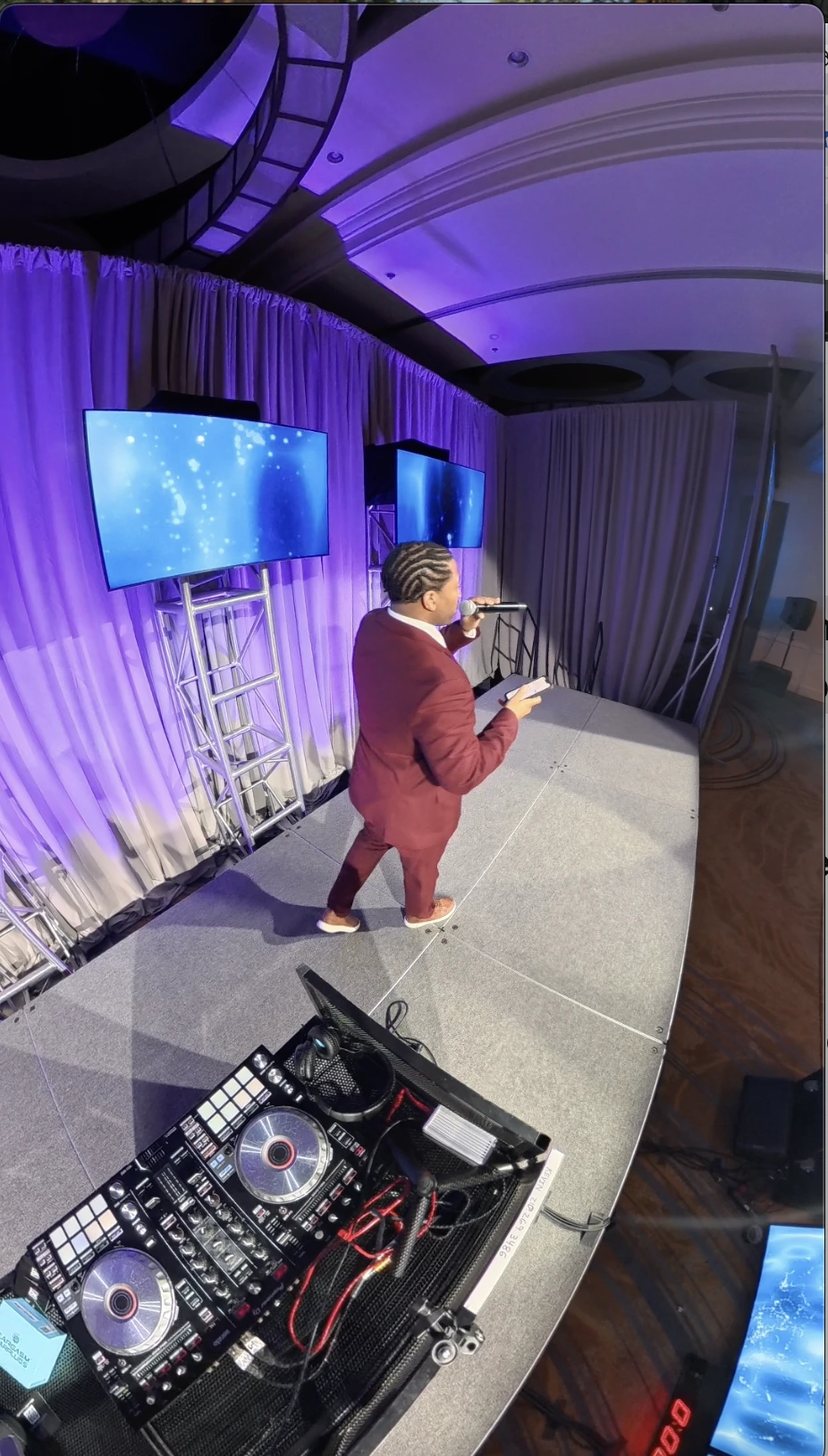
Real Proof: DJ Reese On Site
Real footage of DJ Reese working from a live run of show at a 300 guest conference, the same kind of program flow these scripts are written for.

Rated 5.0 from 121 Google reviews. See real client case studies →
A good emcee script is mostly blank space. The parts that must be exact are short: names, titles, sponsor lines, the award order and the legal wording. Everything else should be a note to yourself, because a room does not respond to paragraphs read aloud.
We write and run scripts for corporate conferences, awards nights, sales kickoffs and activations. This is the format we actually use.
What belongs in writing, word for word
- Names, with pronunciation spelled out the way you would say it out loud, and titles as the person wants them said
- Sponsor recognition lines, approved by whoever owns that relationship
- Award categories in order, with the reveal wording
- Any legal, safety or compliance language
- The one sentence that carries the event message, because it should be said the same way every time it recurs
What should never be scripted
- Reactions to the room. Written enthusiasm sounds written.
- Filler for gaps. A host reading a paragraph while nothing happens is worse than music and a smile.
- Jokes that need a setup. If it needs three sentences, it will not survive a live room.
- Transitions between every segment. Those need intent, not wording.
The two column script we run
Left column is what the audience gets: the line, the name, the cue. Right column is what we need: who is walking from where, what music fires, how long the segment should take, and the out. On a 20 segment morning like the RMS Sales Kickoff in Greenbelt, Maryland, 500 attendees, that right column is what keeps the day on time.
Timing notation that saves you
- Write a planned duration next to every segment, not a clock time. Clock times become lies by the third segment.
- Mark which segments can be cut and which cannot, before the day, not during it.
- Mark the hard stops: a satellite feed, a union break, a venue curfew.
- Leave a written recovery line for a late speaker, so nobody improvises under pressure.
Writing for the ear
Short sentences. One idea per sentence. Names at the end of the introduction, not the middle, so applause lands in the right place. Numbers rounded unless the exact figure is the point. Read every line out loud before it goes in the script, and cut anything you stumble on twice.
Sample structure for an awards night
- Welcome and why we are here, under ninety seconds
- Housekeeping only if it genuinely matters, under thirty seconds
- Sponsor line, exactly as approved
- Category, nominees if used, reveal, walk up music, acceptance window
- Repeat with pace changes so the eleventh award does not feel like the third
- Close on the message, then a hard out
That structure is what we ran for the FTF News Awards at Hard Rock Hotel New York, where every category call and walk up came from the same position. FTF booked us in 2025 and again in 2026.
Frequently asked questions
Do you write the script or do we?
Either. Most clients send an agenda and we return a two column script for approval, then run it.
How late can we change the script?
Up to the moment. Changes get read aloud before doors so nothing is a surprise on stage.
Who owns the script on the day?
Your producer. We follow the show caller, and we flag when a change breaks the timing.
Next step
Send your agenda and the names list. See Emcee vs Speaker vs Host: Which One You Actually Need or check your date.
How much of the day should actually be scripted
Most planners overcorrect in one direction or the other. Either every word is written out, including small talk that should sound spontaneous, or nothing is written down and the emcee is guessing on stage. The right split is closer to 20 percent scripted, 80 percent framework. Score the parts that carry legal, financial, or brand risk word for word. Give the emcee a clear framework and let them run the connective tissue in their own voice.
A useful test: if getting a name, number, or legal phrase wrong would require a correction email the next day, it gets scripted exactly. If getting it wrong just means the moment feels a little flat, it does not need a script, it needs a clear intent and a strong emcee.
What we actually rehearse, and what we don’t
We rehearse the segments with the highest cost of failure: award reveals, executive introductions, anything with a countdown or a live cue to another department (lighting, AV, catering doors opening). We do not rehearse banter, crowd reads, or the lines that depend on what the room is doing in that moment. Over rehearsing those kills the one thing a good emcee brings, which is the sense that they are actually present in the room and not reciting.
- Run the award or reveal sequence at least twice with the actual AV cues, not a stand in.
- Rehearse name pronunciation out loud with whoever provided the names, not from a spelling guess.
- Walk the physical path: where the emcee enters, where they stand, where they exit, and how far that is from the next speaker’s mark.
- Confirm the emcee has a visible clock or countdown that isn’t the same screen the audience sees.
Who signs off on the script, and when
One person needs final approval authority on the script, and that person needs to see it at least 72 hours before the event, not the morning of. We’ve watched last minute “just one more change” requests from three different stakeholders create a script with contradicting instructions. Route every edit through a single owner, usually the event lead or the executive’s chief of staff, and have that person confirm the final version in writing.
Coordinating the script with AV, lighting, and music cues
A script that lives only in a document and never touches the AV run sheet is a script that will fail on show day. Every cue in the right hand column, described above, needs a matching line in whatever the AV team, lighting board operator, or DJ booth is running from. If the emcee’s script says “music fades on my mark” and the booth’s cue sheet doesn’t have that same instruction, the fade either happens too early or doesn’t happen at all. We build our version of this script specifically so it can sit next to the AV run sheet and match line for line.
Scripting for hybrid and livestreamed segments
Hybrid changes what has to be exact. A remote audience can’t read the room the way people in the seats can, so more of the “connective tissue” needs a light script, not because it should sound rehearsed, but because a pause that reads as natural in person can read as dead air on a stream. We also script camera facing acknowledgment lines separately from room facing ones (“for everyone joining us online” is a distinct line, not an ad lib), and we always confirm who calls “we’re live” before the emcee opens.
Common mistakes we see in emcee scripts
- Writing jokes into the script. A joke that needs a setup line almost never survives being read instead of delivered. If humor matters, give the emcee a topic and trust them, don’t write the punchline.
- No fallback for a no show speaker. Every script needs one written line for “the next speaker isn’t ready yet,” so the emcee isn’t inventing a stall in front of the room.
- Treating the script as final once it’s printed. Agendas shift the morning of. The emcee needs a way to get a real time change (a note card, a hand signal, an earpiece) that doesn’t depend on someone finding them in a hallway.
- No one owns pronunciation. A wrong name read confidently is worse than a hesitant correct one. Confirm names with the person who submitted them, not with a guess from the spelling.
- Skipping the exit line. Every segment needs a clean way out, not just a clean way in. Without one, transitions run long because the emcee doesn’t know it’s time to hand off.
Frequently asked questions
How far in advance should an emcee script be finalized?
We ask for a locked version 72 hours before the event, with a final read through the day before. Late changes to names, sponsor lines, or legal wording still happen, but everything else should be settled by then.
Should the emcee write their own script?
The exact wording sections (names, legal language, sponsor credits) should come from the planning team, since that’s information the emcee can’t originate. The connective material is usually better when the emcee has a hand in writing it, in their own voice, rather than performing someone else’s words.
What if the agenda changes the day of the event?
Build a real time way to get the emcee a change: a printed note card system, a hand signal from the stage manager, or an earpiece cue. Whatever the method, decide it in advance. Deciding it in the moment is how announcements get skipped or duplicated.
Do we need a printed script, or is a tablet fine?
Either works if the emcee is comfortable with it. What matters more is redundancy: a battery dying or a tablet freezing shouldn’t take the script down. We usually recommend a printed backup even when the primary copy is digital.
How long should an emcee script be for a half day event?
Length depends on segment count more than event length. A half day event with six transitions needs a shorter script than a half day event with twenty. We size the script to the number of handoffs, not the clock.
Who should have a copy of the final script besides the emcee?
The stage manager, the AV lead, and whoever owns final sign off. Anyone running a cue that the script depends on should have the same version the emcee is holding, not a summary of it.
Can the emcee deviate from the script if something isn’t working?
Yes, for the connective material. No, for the exact wording sections. That distinction is the reason we separate the two in the first place: it tells the emcee exactly where they have room to adapt and where they don’t.
What’s the biggest sign a script wasn’t tested against the run sheet?
A cue in the script that has no matching line on the AV or lighting sheet. That mismatch is the single most common cause of a cue firing at the wrong moment or not firing at all.
Frequently Asked Questions
What should you plan for first with this type of event?
Written enthusiasm sounds written. A host reading a paragraph while nothing happens is worse than music and a smile.
What’s the most common mistake to avoid?
Left column is what the audience gets: the line, the name, the cue. Right column is what we need: who is walking from where, what music fires, how long the segment should take, and the out.
What actually matters most on the day?
Write a planned duration next to every segment, not a clock time. Clock times become lies by the third segment.