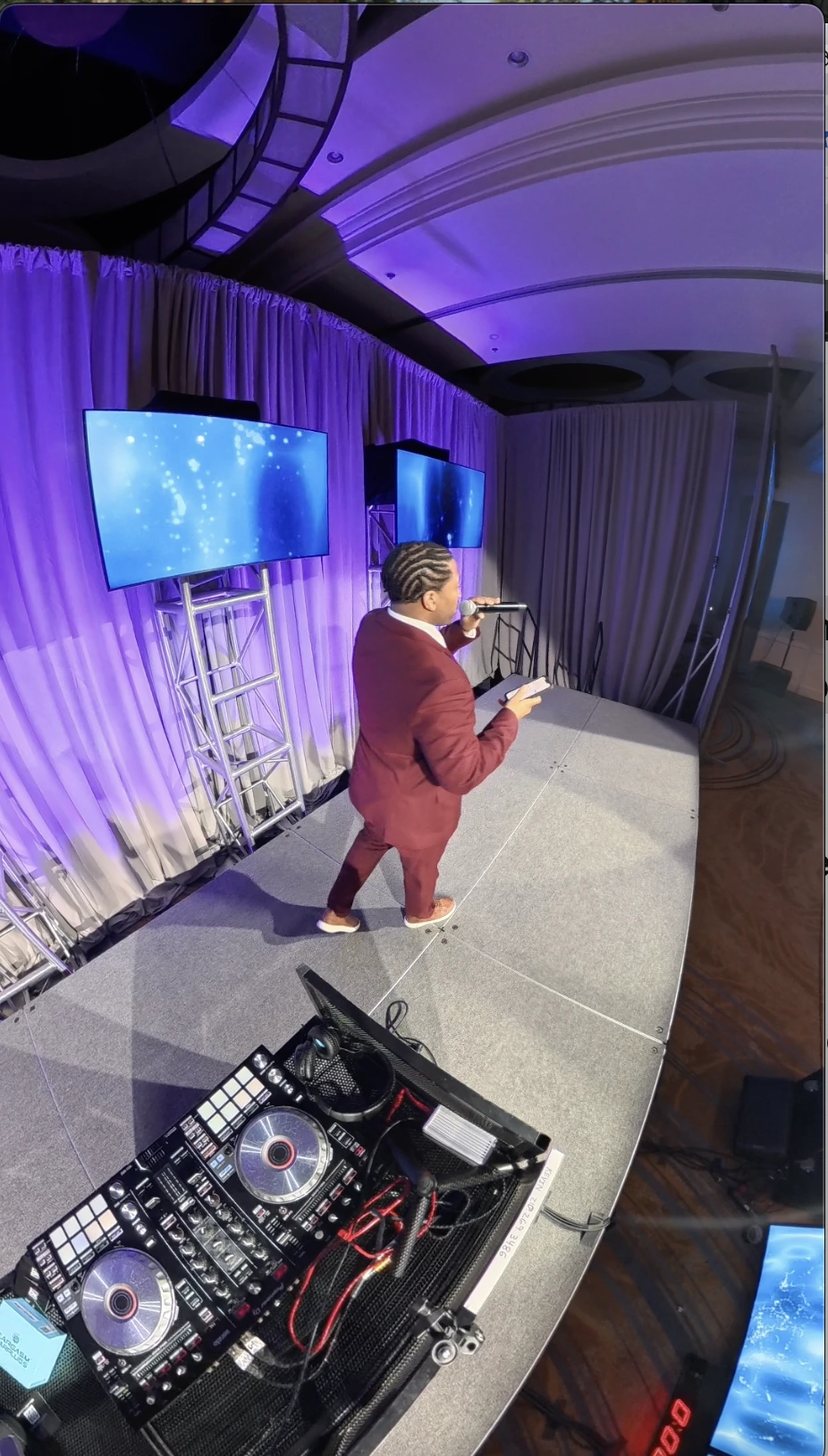
Where we have done this work: we emceed the open and DJed the FTF News Technology Innovation Awards at the Hard Rock Hotel New York in 2025 and 2026, a technology awards night for the financial technology industry: we welcomed the room, introduced the founder and played every winner’s walk up. We have not yet run a multi day software user conference, so below is how we would program keynotes, product demos and a user summit.
A tech user conference has an energy problem that no other corporate conference has. The room is full of people who came for the product, the sessions are dense, the lighting is set for screens rather than for humans, and the audience is culturally allergic to anything that feels like hype. Program it like a sales event and the room will visibly opt out.
“What a joy it was to have DJ, so much so we hired him for our next 2 festival shows! Did such a great job working the crowd. Highly recommended him!”
, Christina C., verified client review

5.0 from 121 Google reviews.
A tech user conference has an energy problem that no other corporate conference has. The room is full of people who came for the product, the sessions are dense, the lighting is set for screens rather than for humans, and the audience is culturally allergic to anything that feels like hype. Program it like a sales event and the room will visibly opt out.
The room is dark and that changes everything
Developer and product conferences are lit for projection. Houselights down, screen bright, audience invisible from the stage. That has three consequences most planners do not plan for.
- Nobody can see the audience, including the people on stage, so applause and reaction are the only feedback anyone gets. Leaving space for them matters more than usual.
- Attendees are on laptops and phones during sessions, which is normal at a tech conference and not disengagement. Do not program around trying to stop it.
- Transitions between a dark session room and a lit reception are physically jarring. The lighting change, the volume change and the format change should not all land in the same 30 seconds.
The keynote is a production, not a speech
Product keynotes have cues: a demo, a reveal, a number on a screen, a guest walking on. Every one of those has a timing relationship with audio, and every one of them can be rehearsed or not.
The failures are consistent. A demo that runs long and pushes the whole morning. A reveal where the music peaks before the screen changes. A live demo that fails, which happens, and a room left in silence while somebody debugs. That last one needs a plan agreed in advance: what plays, who decides, and how long before the host steps in.
Demo failure is a normal operating condition
At a tech conference, something on stage will not work at some point. The audience is more forgiving of this than any other corporate crowd, provided the room handles it without panic. What kills it is dead air and visible stress.
We plan the recovery as a segment: an audio bed that comes up at a specific cue, a host line that acknowledges it plainly rather than pretending, and a defined point at which the program moves on without the demo. At a life sciences summit in Newark we had a microphone fail in front of roughly 300 attendees and the room was moving again in about eight seconds, because the recovery existed before it was needed. Same discipline, different failure.
Hybrid and streaming
Most tech conferences stream. That means the audio going to the room and the audio going to the feed are two different products, and the person mixing one is often not thinking about the other.
Practical consequences: music that fills a room reads as overwhelming on a stream, applause that sounds warm in the hall sounds thin online, and silence during a transition feels twice as long to a remote viewer. Somebody needs to own what the remote audience hears during every gap, and that is usually nobody.
The after party and the culture question
Tech conference evening events have a specific dynamic. A large part of the audience is introverted, travelling alone, and would rather have a conversation than a dance floor. A smaller part very much wants the dance floor.
The build that works serves both: a genuinely quiet area that is actually quiet rather than nominally quiet, a floor for the people who want it, and enough physical separation that neither ruins the other. Volume decisions get made for the conversation zone first, because the people who want to dance will come to the floor regardless and the people who want to talk will leave the building.
What we need to program it
- The keynote cue sheet, including every demo and reveal with its expected length.
- Who controls the screens and whether we can rehearse against them in the room.
- Whether the event streams, and who owns the feed audio.
- The session room turnaround times, which determine how much cover music is needed and when.
- Names and pronunciations for everyone walking on stage, including engineers who are not regular presenters and will be nervous.
Questions we get
Does a tech conference even need a DJ
It needs somebody owning audio and timing across the general session, the transitions and the evening. Whether that person also plays music is secondary. The conferences that feel tight are the ones where one person held all three.
Will our audience find it corny
They will if you program it like a stadium. They will not if the music is good, the volume is right and nobody is being asked to make noise on command. Tech audiences respond to competence, not enthusiasm.
How early do you need the run of show
Two weeks for a conference with a produced keynote, and we expect it to change. What we need early is the structure, not the final wording.
This kind of technology conference programming is the same skill set DJ Reese brought to the 2026 FTF News Technology Innovation Awards, where he DJ’d and emceed the fintech industry’s own awards event in New York City.
Next step
Send us the agenda and the keynote outline. We will tell you where the timing is optimistic and what the demo contingency should be. Most corporate events book us 60 to 90 days out.
Frequently Asked Questions
What should you plan for first with this type of event?
Developer and product conferences are lit for projection. Houselights down, screen bright, audience invisible from the stage.
What’s the most common mistake to avoid?
Product keynotes have cues: a demo, a reveal, a number on a screen, a guest walking on. Every one of those has a timing relationship with audio, and every one of them can be rehearsed or not.
What actually matters most on the day?
At a tech conference, something on stage will not work at some point. The audience is more forgiving of this than any other corporate crowd, provided the room handles it without panic.