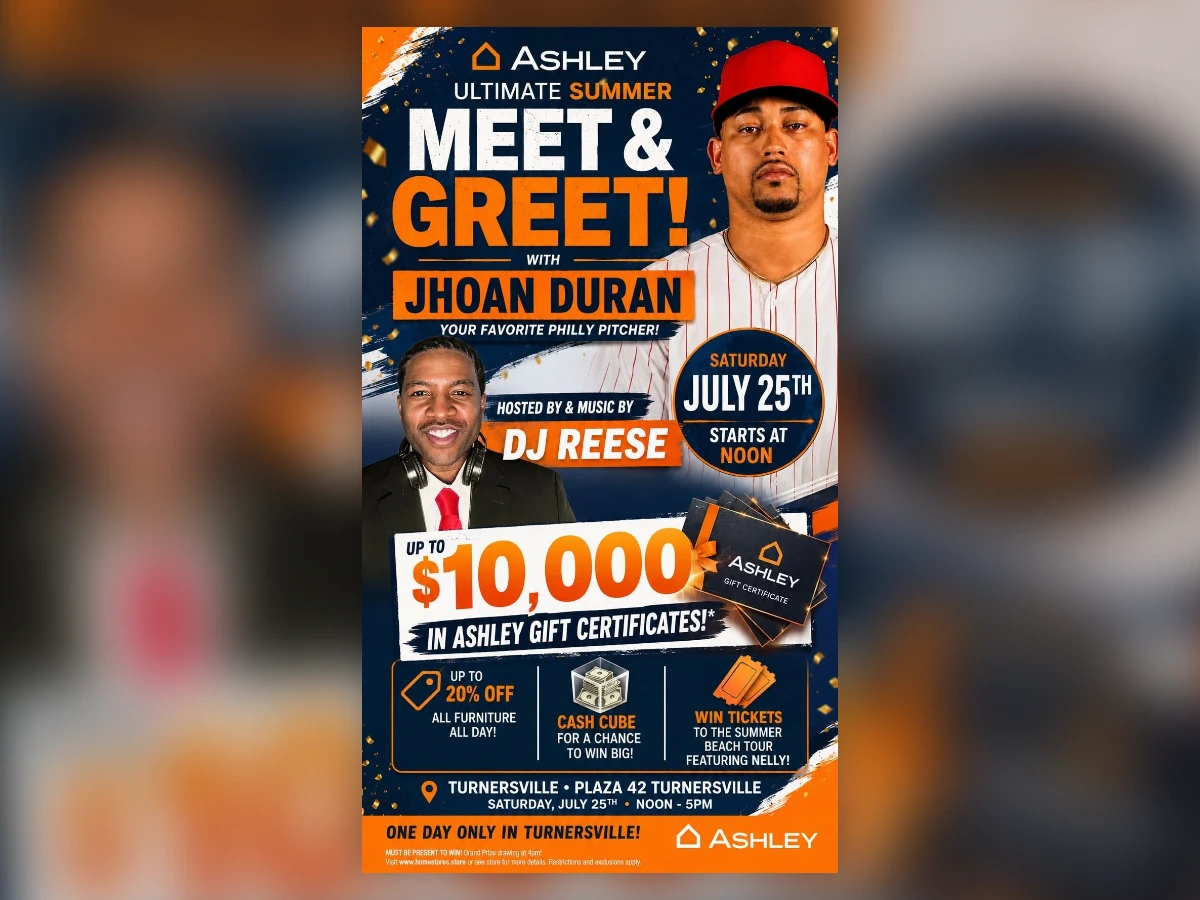
This Saturday, July 25th, we are hosting and DJing the Ashley Ultimate Summer Meet & Greet with Phillies pitcher Jhoan Duran at the Ashley Furniture store in Turnersville, NJ. Noon to 5pm, up to $10,000 in Ashley gift certificates on the line, a cash cube, 20% off furniture storewide, and a shot at tickets to the Summer Beach Tour featuring Nelly. On paper, it reads like a simple in-store promotion. In practice, it’s a brand activation event, and a brand activation event only works if every role involved does its job at the same time, in the same room, for the same five hours.
We have hosted this exact format before for Ashley Furniture and Regency Management Services, including a meet and greet with Sixers guard Tyrese Maxey. The athlete changes. The stakes change. The mechanics of what makes a brand activation event succeed do not. This post breaks down what a brand activation event actually is, why it matters more than a standard promotional event, who has to show up and do their part for it to work, and what we have learned running enough of them to know exactly where they tend to fall apart.

What Is a Brand Activation Event, Really
A brand activation event is different from a standard promotion because it’s built around a live experience, not just a discount. A sale gets someone to buy. A brand activation event gets someone to show up, participate, and remember the brand as something more than a store. The goal is to turn a passive shopper into an active participant, if only for an afternoon, and to turn that afternoon into something people talk about, post, and come back for.
That’s the entire logic behind Saturday’s event. Ashley Furniture isn’t just running a furniture sale. They’re building a live activation around a recognizable athlete, real prizes, and a host managing the room, because that combination creates a reason to be in the store beyond needing a couch. A markdown competes on price. An activation like this one competes on experience, and experience is a lot harder for a competitor down the street to copy.
Why a Brand Activation Event Matters More Than a Standard Promotion
We have seen the return on this firsthand. A PUMA brand activation event We worked generated $70,000 in sales in three hours by focusing entirely on dwell time, how long people stayed engaged in the space, rather than just counting foot traffic through the door. LIDL US has run more than 60 grand opening activations over a seven-year partnership for the same reason: a well-run event doesn’t just move product for one day, it builds a pattern people show up for the next time too.
That’s the return a brand activation event offers that a flyer or a storewide markdown never will. Nobody posts a photo of a sale sign. People post a photo of themselves meeting a Phillies pitcher, and that photo does more marketing after the fact than the ad that got them there in the first place.
What Brands Actually Get Back From a Brand Activation Event
Every brand activation event has to justify its cost against something more concrete than “people had fun.” The retailers and agencies we work with track a handful of numbers: incremental foot traffic on the day, dwell time inside the store or venue, and the direct sales lift tied to the event window. PUMA generated $70,000 in product sales during a three-hour dwell-time activation. LIDL has run more than 60 grand openings on the same activation model because the foot-traffic numbers hold up store after store. Those aren’t soft metrics. They’re the reason a brand activation event gets budget approved a second time.
The Ashley Furniture event this Saturday is built around the same logic, just with different levers. Up to $10,000 in gift certificates, a cash cube giveaway, and a shot at Summer Beach Tour tickets aren’t decoration. They’re the mechanism that gets someone off the sidewalk and into the store, and once they’re inside, the 20% storewide discount does the work of converting a visit into a sale. A brand activation event that skips this step and relies on the athlete appearance alone will draw a crowd that watches and leaves.
There’s a second return that matters just as much and shows up slower: content and referrals. Every well-run brand activation event produces photos, video, and word of mouth that outlast the day itself, and every rebooking we get from a past client is really a vote that the numbers behind that event held up. That’s a more honest measure of success than attendance count alone.
Every Role in a Brand Activation Event Has to Work Together
Here’s what most people underestimate about a brand activation event: no single element carries it. The athlete doesn’t carry it alone. The prizes don’t carry it alone. It succeeds or fails based on whether every role involved is doing its specific job at the same time.
The Brand or Retail Partner
Every brand activation event starts with the brand setting the stakes. For Saturday, that’s Ashley Furniture putting real money behind it: up to $10,000 in gift certificates, 20% off storewide, and a cash cube giveaway. An event with weak stakes gets weak turnout, no matter who else is involved or how good the host is.
The Draw or Talent
Jhoan Duran gives people a reason to drive to Turnersville on a Saturday instead of just clicking a sale link from the couch they’re about to replace. The right talent for a brand activation event isn’t necessarily the biggest name available, it’s the name that actually matches the audience the brand is trying to reach. A mismatch between talent and audience is one of the most common reasons this kind of event underperforms, no matter how much the appearance fee cost.
The Venue
The Turnersville store itself has to be built for flow: line management, photo moments, and enough open space that a brand activation event doesn’t turn into a bottleneck by 1pm. Venue logistics rarely get credit when things go well and almost always get blamed when they don’t, which is exactly why they need to be planned first, not fixed on the fly.
The Host and DJ
This is where our role comes in on Saturday, and it’s the role most people don’t think about when they picture a brand activation event. Someone has to manage the energy in the room in real time: keeping the line moving, timing the prize drawings, filling the gaps between meet and greet moments so the room never goes flat, and reading the crowd well enough to know when to build energy and when to let a moment breathe.
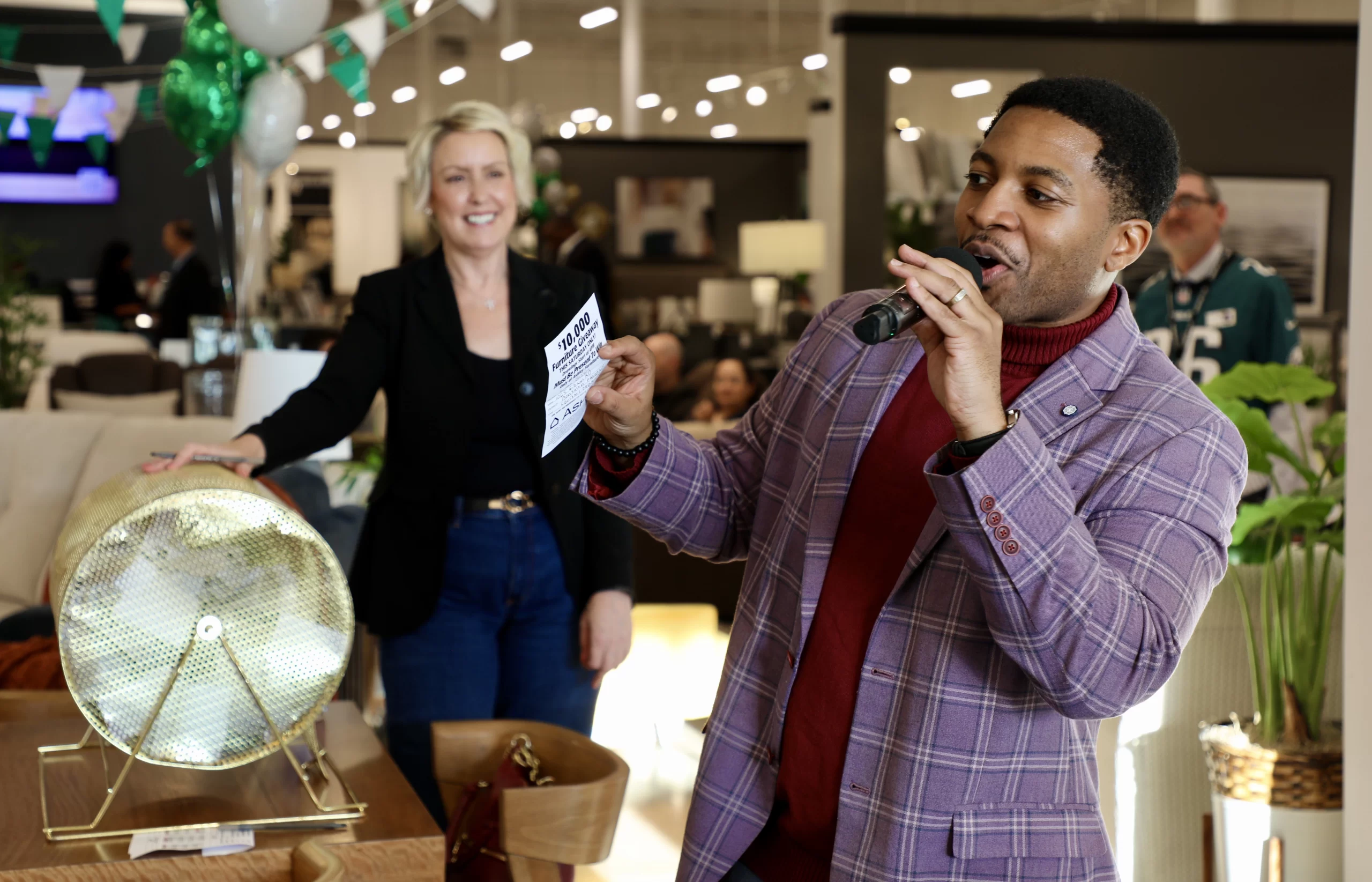
An event with a great athlete and a distracted host still falls flat, because the host is the one role that’s live and adjusting for the entire five hours while everything else is fixed in place. That’s the same approach we bring to Brand Activation DJ and Emcee for Experiential Marketing for every client, not just Ashley Furniture.
The Staff on the Floor
Energy has to convert into something. Once people are engaged and excited, the sales staff is what turns that into an actual furniture purchase, a store credit signup, or a customer who comes back in the fall. A brand activation event can do everything else right and still underperform if the floor staff isn’t briefed and ready for the traffic it creates.
Pull any one of these roles out, or let one of them underperform, and the whole event feels off, even if nobody in the room could tell you exactly why.
How Far in Advance to Plan a Brand Activation Event
Talent booking is usually the long pole. Athletes and other draws need to be locked in well before anything else, often 60 to 90 days out for a name with real pull, since their schedules fill fast and appearance windows are narrow.
Venue and staffing logistics can move faster, but they still need real lead time: the store has to plan floor layout changes, staff schedules have to account for the extra traffic, and prize structures like Saturday’s gift certificates and cash cube need approval and stock on hand before the doors open. A brand activation event planned two weeks out is almost always a weaker version of the same idea planned two months out, because the roles above don’t have time to actually coordinate with each other.
Common Mistakes That Sink a Brand Activation Event
The failure pattern is consistent enough to spot before it happens. A brand activation event usually underdelivers for one of a handful of reasons: the talent doesn’t match who actually shops there, nobody owns the room’s energy so it peaks early and dies by hour two, the venue layout creates a bottleneck that turns excitement into a frustrated line, or the sales staff never got briefed on how to use the moment once it’s created. None of these are talent problems or budget problems. They’re coordination problems, and coordination is exactly what separates an activation that gets talked about from one that just gets tolerated.
The mistake we see most often, though, is treating a brand activation event like a single point of failure instead of a system with a backup plan. Talent schedules shift, weather moves an outdoor setup indoors, a delivery gets delayed. The activations that recover in the moment are the ones where someone worked out the contingency in advance: a backup announcement plan if the athlete runs late, a floor plan that still functions if attendance runs higher or lower than projected, and one person with the authority to make a call without waiting on five people to sign off.
A brand activation event with a strong concept and no contingency plan is still a gamble. One with both is a system that performs whether or not everything goes exactly as scripted.
Why Brands Keep Investing in Experiential Activations
Traditional advertising tells people what a brand is. An experiential activation lets people feel it, and that difference is why retailers, sports teams, and Fortune 500 companies keep putting budget into live, in-person moments instead of another round of banner ads. An ad interrupts someone’s day. A good activation becomes part of it. Someone standing in line to meet Jhoan Duran isn’t thinking about Ashley Furniture as a category of store, they’re having an experience they chose to be part of, and that shift, from being marketed to, to opting in, is the entire value proposition of experiential marketing.
It also compounds in a way a sale never does. A discount ends the moment the promotion does. A memory of meeting a player, winning from a cash cube, or being in the room for something that felt genuinely fun sticks around, gets mentioned to friends, and shapes how someone talks about a brand long after the receipt is gone. That’s the real goal behind Saturday, and behind every activation we have worked: not just moving product for five hours, but giving people a reason to think of the brand differently the next time they need what it sells.
What This Looks Like This Saturday
Here’s how it comes together for this specific event. Doors open at noon at the Ashley Furniture store, Plaza 42 in Turnersville. We are on music and hosting duties from open to close, running the room the same way we would a corporate brand activation event: managing transitions, keeping the line to meet Jhoan Duran moving, calling attention to the cash cube moments as they happen, and building toward the grand prize drawing at 4pm. Every guest who comes through is in the running for a share of the $10,000 in Ashley gift certificates, on top of 20% off furniture storewide and a chance at Summer Beach Tour tickets. One day only, Turnersville location, noon to 5pm.
Turnersville sits in the Corporate Event DJ in South Jersey and Cherry Hill market just outside Philadelphia Corporate Event DJ and Emcee | DJ Reese, which is exactly why a Philadelphia 76ers player was the draw: the activation was built to pull from both metro audiences in one day.
How to Know If a Brand Activation Event Will Actually Work Before You Book It
Whether it’s a retail meet and greet like Saturday’s or a corporate activation, the same checklist applies before you commit budget to it:
- There’s one clear goal for the event, whether that’s foot traffic, sales, sign-ups, or brand awareness, not all four at once
- The talent or draw actually matches the audience the brand wants in the room
- One person owns the energy and flow of the room for the entire event, not a rotating cast of people half-managing it
- Staff are briefed in advance on how to convert the energy into an actual result
- There’s a built-in, shareable moment, like a photo opportunity or a prize reveal, that gives people a reason to post about it
A brand activation event that checks all five is one that’s built to work. Miss two or three, and it becomes an expensive way to hand out furniture discounts.
For anyone deciding whether it’s worth the drive, here’s what the day actually looks like on the ground. Guests get a real meet-and-greet window with Duran, not a wave-and-walk-by. There’s time built in for photos, and the energy on the floor stays up between appearances instead of going flat while people wait. That’s the part a lot of brand activation event plans get wrong: they book the talent and treat everything around the appearance as filler.
Here, the music, the giveaways, and the countdown to the 4pm drawing are all working together to keep the room engaged whether Duran is at the table or on a break. If you’re in South Jersey this Saturday, that’s the version of a brand activation event worth showing up for.
Brand Activation Event FAQ
What’s the difference between a brand activation event and a regular promotional event?
A regular promotion is built around a discount. A brand activation event is built around a live experience, an athlete appearance, a giveaway, a host managing the room, designed to turn a passive shopper into an engaged participant and give people a reason to remember and share the brand beyond the sale itself.
Who should host or DJ a brand activation event?
Whoever hosts a brand activation event needs to do more than play music or make announcements. They need to manage timing, read the crowd, keep the energy up through natural lulls, and coordinate with talent, staff, and venue in real time. That’s the same skill set we bring through our Brand Activation DJ and Emcee for Experiential Marketing.
How do you measure whether a brand activation event worked?
Dwell time, foot traffic conversion, and repeat engagement are the strongest indicators. The PUMA event we hosted generated $70,000 in three hours by focusing on how long people stayed engaged, not just how many walked in the door.
Built for Brand Activation Events That Actually Perform
We are About DJ Reese | No Stress Zone Entertainment, and running the room for a brand activation event, whether it’s a retail meet and greet like Saturday’s Ashley Furniture event or a corporate Corporate Event DJ and Emcee Services, Nationwide, comes down to the same job: read the room, manage the energy, and make sure every other role, the brand, the talent, the venue, and the staff, has the conditions it needs to succeed. See more of that work on the Corporate DJ Case Studies: Fortune 500 Brand Partners, or reach out to talk through what a brand activation event could look like for your next launch.