Everything a planner controls is decided before doors. The run of show, the cues, the names, the equipment. Then the event starts and a different job begins, one that cannot be written down in advance, and it is the job we are actually hired for.
“We had a great experience and enjoyed working with this DJ. He was on time to our event, was kind, adaptable and played great music. His equipment was high quality and he did an excellent job on the mic making announcements and helping us navigate our event. Our company will be hiring him for any and all future events.”
, Ruth Gameiro, verified client review
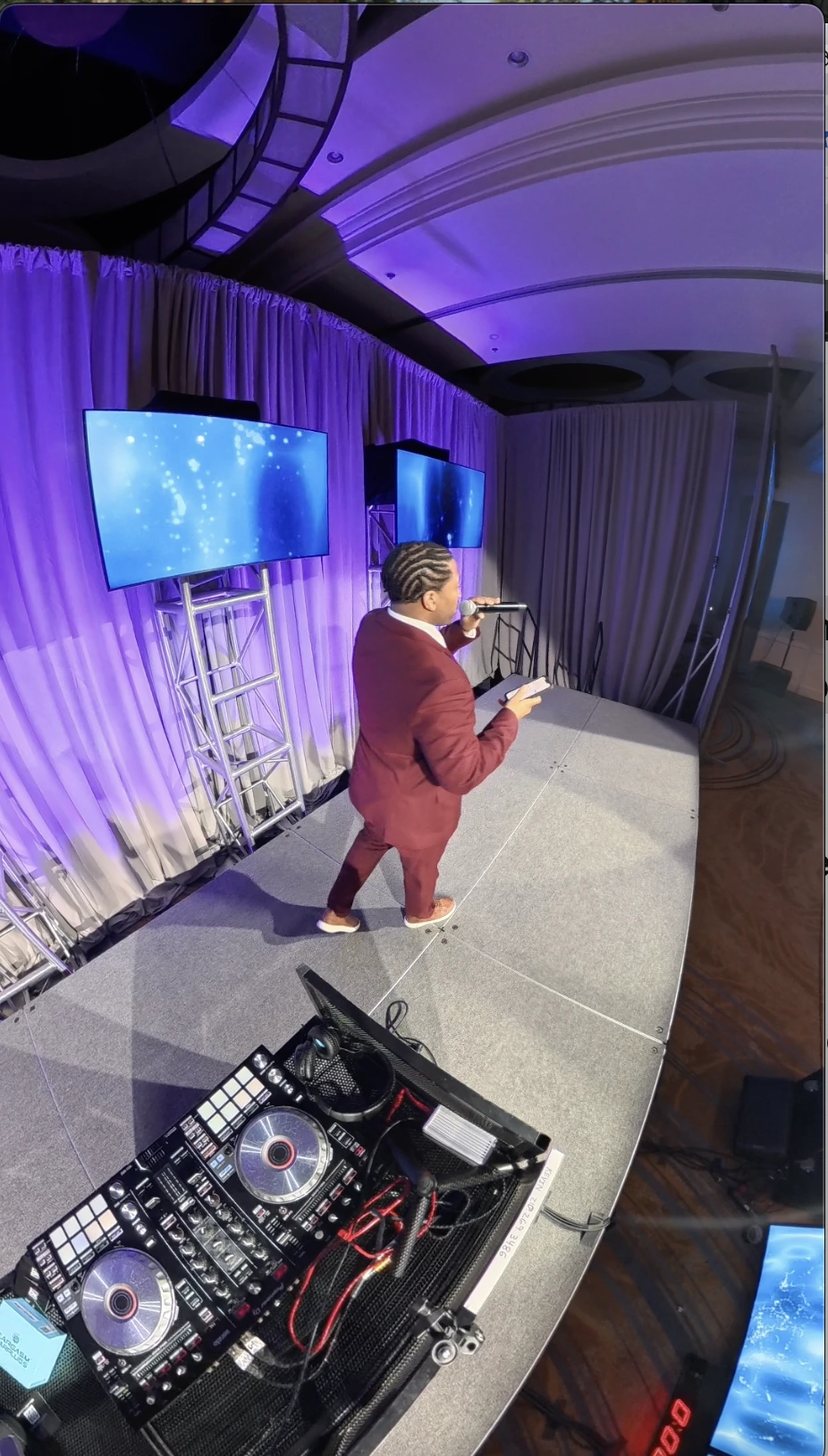
Real Proof: DJ Reese On Site
Real time operator judgment, shown rather than described: DJ Reese reading the room and running program flow live at a 300 guest conference.

Rated 5.0 from 121 Google reviews. See real client case studies →
Everything a planner controls is decided before doors. The run of show, the cues, the names, the equipment. Then the event starts and a different job begins, one that cannot be written down in advance, and it is the job we are actually hired for.
This page is about that job: what decisions get made in the room, what the signals are, and how fast they have to happen.
The room tells you before the numbers do
Post event surveys tell you what happened. They arrive days later and they are answered by the people who liked it enough to respond. The room tells you in real time, and it tells you in body language.
- Phones out across a section, not individually. One person on a phone is normal. A quarter of a section at once means the content lost them about two minutes ago.
- The drift toward the back and the doors. People do not leave suddenly, they migrate first.
- Conversation volume rising over a speaker. That is not rudeness, it is a room that has stopped receiving.
- Tables not refilling after a break. If the room comes back at eighty percent, the back half of your agenda has a problem that nobody has told you about.
- People standing near their chairs talking louder. That is the pre dance signal and it is the moment a floor opens, not any particular song.
- The far corners. The people having the worst time are always at the edges, and they are the earliest indicator.
What can actually be changed live
Not much, which is why knowing what is adjustable matters more than watching closely.
- Volume and energy, instantly.
- The order of what comes next, if the run of show marked items as compressible or cuttable.
- How long a gap runs before something fills it.
- Which panelist gets the next question.
- Whether the floor opens now or in fifteen minutes.
- Whether a segment gets a longer applause window or gets moved along.
A vendor who can read the room but does not control any of those is a spectator. That is the practical argument for one person holding the microphone, the music and the schedule: the decision and the ability to act sit in the same place.
Speed is the whole thing
Recovery time is what an audience remembers, not the failure. A microphone that dies and is replaced in eight seconds is an event where something briefly happened. The same failure taking ninety seconds is an event with a problem in it, and the room will describe it that way afterwards.
At a life sciences summit at the Marriott Newark Airport, a microphone failed mid program in front of roughly 300 senior attendees. The room was moving again in about eight seconds. That was not quick thinking. The spare was already powered on, the recovery had been decided in advance, and the only live decision was to use it.
That is the actual pattern. Good real time operation is mostly pre made decisions executed without hesitation. Improvisation is what happens when the preparation was not done.
The decisions that are made every event
- A speech runs long. Absorb it or cut something. Decide before it becomes visible from the seats.
- A segment lands flatter than expected. Move on faster rather than trying to rescue it.
- The room is warmer than expected. Take the opportunity and lift now, because the window closes.
- A recipient is not in the room. Move without leaving a build unresolved.
- The scoring is not finished. Fill the gap with something planned rather than letting silence sit.
- The floor is not going to fill. Stop trying, hold the room at conversation level, and let the night end well.
That last one is the discipline most operators lack. Pushing volume at a room that does not want to dance is the most common visible failure in corporate entertainment, and it is a decision to keep making rather than a single mistake.
Reading a room is not intuition
It gets described as instinct, which makes it sound unteachable and unaccountable. It is closer to pattern recognition built from repetition, and it depends entirely on having somewhere to look. A vendor behind a booth staring at a laptop is not reading anything.
It also depends on knowing the room before it fills. Where the senior table is sitting, which corner the sound does not reach, where the doors are, who is likely to leave early. Most of what looks like live judgment is preparation being spent.
Questions we get
How do you know when to open the floor
When people are standing near their chairs talking louder. Not the clock, and not the end of the program.
What do you do when nothing is working
Lower the volume and let the room be a room. A crowd that will not engage does not engage harder because the music got louder, and the attempt is visible.
Can this be split across two vendors
It can, and it is slower. The observation and the control end up in different hands, and everything has to be communicated before it can be acted on.
Next step
Send us your run of show and we will mark which items we would treat as compressible and cuttable before the day, so the live decisions are decisions rather than improvisation.
Frequently Asked Questions
What should you plan for first with this type of event?
Post event surveys tell you what happened. They arrive days later and they are answered by the people who liked it enough to respond.
What’s the most common mistake to avoid?
Not much, which is why knowing what is adjustable matters more than watching closely. Volume and energy, instantly.
What actually matters most on the day?
Recovery time is what an audience remembers, not the failure. A microphone that dies and is replaced in eight seconds is an event where something briefly happened.